
‘Birthplace’ of the NHS in a sorry state
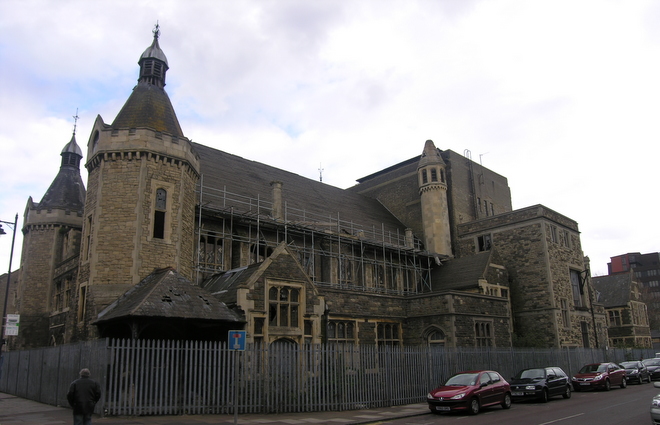
Photo Credit: Adam Slater
Grade II*-listed, 1853, Edward Roberts
A striking sight from the railway, the Mechanics’ Institute is a grand, Tudor Gothic building of truly national significance. It was built as a community centre for and by workers on the Great Western Railway, and provided them with facilities which were unusual for the time. When the Institute was completed to a design by Edward Roberts in 1855, it included refreshment rooms, a market hall, and a bathhouse, as well as the first lending library in Britain, but some of these features were removed following an extensive redevelopment overseen by Brightwen Binyon in 1892. The demolition of the market hall and bathhouse allowed for the extension of the main building to incorporate new events spaces, including a billiards room, a smoking room, and a theatre with a proscenium arch stage.
The late twentieth century saw the building decline, and after it closed in 1986, the Institute fell prey to vandals and arsonists, and to a campaign proposing to demolish it and develop the land. This is an important building that needs protection and support, as well as a workable plan to ensure a sustainable future. If the private owner is unwilling to provide this, then Swindon Borough Council, whose policy is to preserve the Institute, should issue the owner with an urgent works notice.
Status Update / March 2026
The legal reinstatement of Forefront Estates on Companies House in 2018 had significant implications for the Mechanics’ Institute, because the company was its former owner. The process saw all assets gradually returned to their ownership, including property, but they have not indicated any interest in the building and its condition has deteriorated further. In 2020, the local council completed a conditions survey, which estimated the total cost of the capital works and established a list of conservation priorities. Some of these works were completed in March 2023 following a grant of £10,000 from Historic England, but further works are required including the removal of invasive plants. The building has a strong local following but the absence of the owner makes it difficult to develop a more comprehensive restoration strategy and identify a long-term and sustainable use.