
St. John’s Wood, City of Westminster
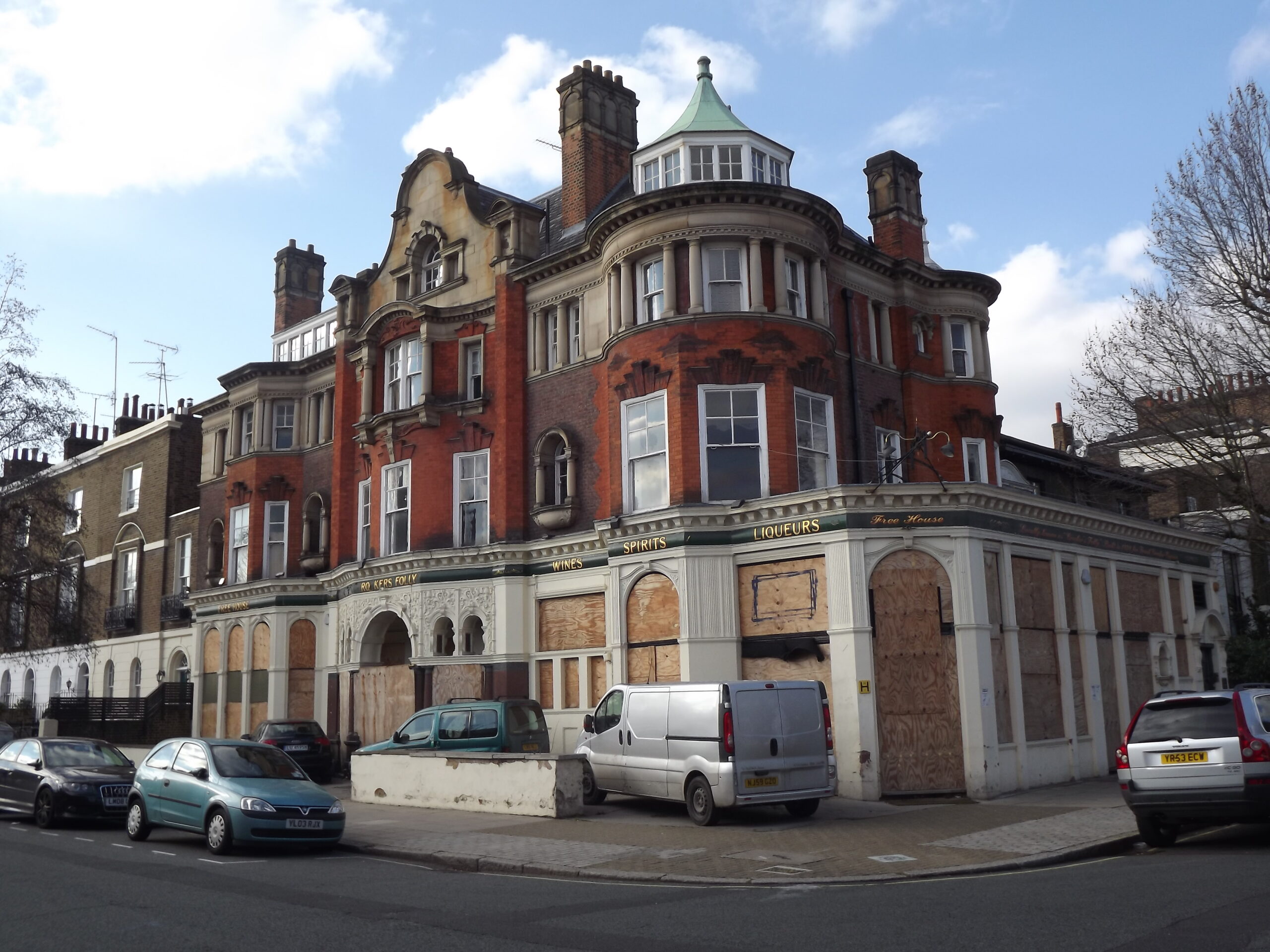
Crocker’s Folly by Colin Smith, CC BY-SA 2.0
Grade II*-listed, 1900, C.H. Worley
From its opening until 1987, ‘Crocker’s Folly’ was known as the Crown Hotel. The name change can be attributed to an urban legend, which held that Frank Crocker had commissioned the building to serve the Great Central Railway’s new terminus at Marylebone, only for it to be constructed half a mile away. It is sometimes claimed that this resulted in his ruin, despair, and eventual suicide, and that this ghost haunts the interior to this day. In truth, he died of natural causes, and the grand scale of the building can be attributed to the fierce competition introduced by the building boom at the time.
The Crown was built during the ‘Golden Age’ of pub building in Britain, and has been described variously as ‘a showcase Victorian pub’ and ‘a truly magnificent pub-cum-hotel’. Designed by local architect Charles Worley in 1896, it is considered an unusually elaborate and eclectic work of the Northern Renaissance style. The fittings are essentially original and are notable for incorporating more than fifty varieties of marble. Of particular interest is the ‘grand saloon’, as it was originally known, which includes a well-preserved marble fireplace, an L-shaped marble counter and bar, and paired marble Corinthian pilasters, which in turn support an ornate, part-gilded beamed ceiling.
The pub closed in the autumn of 2004 and since then its condition has deteriorated. It is now listed on the Historic England heritage at risk register and is considered at risk of rapid deterioration of loss of fabric. We, CAMRA, and others are campaigning for the safeguarding of this outstanding community asset, which, along with many other historic inns and hostelries, is suffering from lack of use.
Status Update / March 2026
In the spring 2011, a planning application was submitted for the conversion of the upper floors to residential use. This was granted later that year and works were undertaken to repair the building and adapt it to a new use. An application to restore the ground floor was approved in 2014, and it now operates as a popular Lebanese restaurant.