
Derbyshire railway warehouse left derelict for an unbelievable 50 years and at tipping point
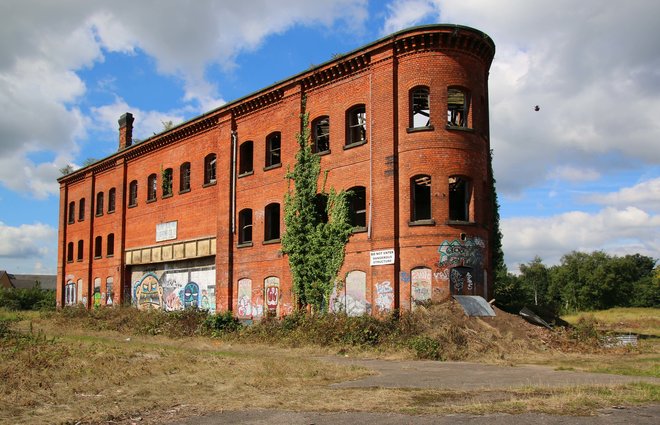
Grade II-listed, 1877, Kirk and Randall
This large railway warehouse bordering a roundabout on the outskirts of Derby has been left derelict for a remarkable fifty years. It was built in 1877 by Kirk and Randall as part of the Great Northern Railway at Friargate Station and was listed at Grade II in 1986, partly on account of its association with Derby’s rich railway heritage, but also because it is an unusual example of its type. The sheer size and distinctive shape of the building make it stand out from examples found elsewhere: it runs to a length of twenty-one bays and stands three storeys high; and it is arranged across a rectangle plan, with a triangle office block with a mezzanine floor to the east. Planning permission was granted for the site to be redeveloped into a large-scale shopping and accommodation complex in 2011, with the warehouse functioning as a new supermarket, but these plans have since stalled. The building is a frequent target of arson attacks and is at a tipping point in terms of conservation deficit, with emergency action needed to prevent further damage from compromising its feasibility.
Christopher Costelloe, The Victorian Society Director, said: ‘This large and distinctive Victorian warehouse could be repurposed into a focal point of Derby; instead it has steadily become a giant eyesore, with its architectural and historical interest eroding away. We hope that its inclusion in this year’s Top 10 list will re-inspire the owners to realise its obvious potential and revive it into a community space Derby can be proud of’.
Status Update / March 2026
A proposal to restore and redevelop the entire site was submitted for planning in 2019, and since then, significant progress has been made. The Great Northern masterplan envisions the transformation of the bonded warehouse and engine house into a commercial hub, organising a new, flexible workspace, health and fitness facilities, and a restaurant around a dramatic triple height atrium. The project was privately financed, with structural interventions in the heritage structure subsidised with newbuild development on the surrounding land, which delivered 276 terraced houses. Its design emphasises sustainability, according to the architect, relying on low carbon materials, low-energy construction techniques, and on-site renewable energy generation.