
Easington, County Durham
Mick Garratt, CC BY-SA 2.0
Grade II-listed, 1899, J. Morson
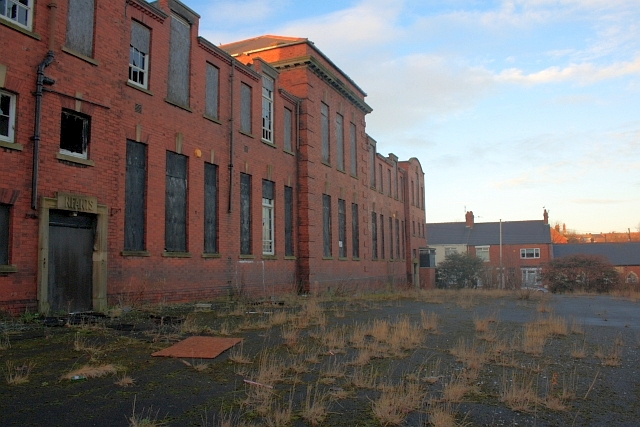
Easington Colliery School was commissioned in 1899 when a coal mine opened locally, effecting significant demographic changes in an otherwise sparsely populated rural area. That year, thousands of miners came from all parts of Britain and Ireland, bringing their children with them, and as such the local council decided to construct a school of exceptional size, with a capacity of more than 1,700 pupils. The buildings were erected on previously vacant land, close to several blocks of near-contemporary terraced houses, and dominated sight lines from the surrounding streets, no doubt to emphasise the importance of education in a community almost entirely dependent on mining.
The school buildings are of redbrick with concrete dressings, and arranged around a sequence of playgrounds, bounded by brick walls with wrought iron gates and railings. The rationale behind the plan form can still be read in the architectural massing, dominated by two equally-sized teaching blocks of two storeys. One of these blocks was for boys, and the other for girls, with the upper and lower storeys accommodating infants and seniors respectively. The placement of the single-storey ancillary structures, such as the latrine, manual construction, and cooking blocks, indicates that certain activities were either restricted or segregated along age and gender lines.
The school remained in its original use throughout the twentieth century, retaining its original plan, as well as period fixtures and fittings, but ultimately closed in 1998, and when its replacement opened later that year, the council voted to offload the listed buildings for a nominal sum of £1. Since then they have been boarded up and left to deteriorate, attracting vermin, much to the annoyance of the local community. The Victorian Society successfully opposed the developers’ demolition proposals at a public inquiry earlier this year, but a satisfactory use for the buildings has yet to be found.
Status Update / March 2026
The local council regained ownership of the site in 2020, and subsequently submitted a planning application to clear the site and establish a pocket park until a permanent use for the land could be established. The plans received approval, following a consultation process, and the demolition of all the listed school buildings, with the exception of the ‘Master’s House’, was completed in 2025.