
Public access to WWI memorial and fine vaulted chamber at risk
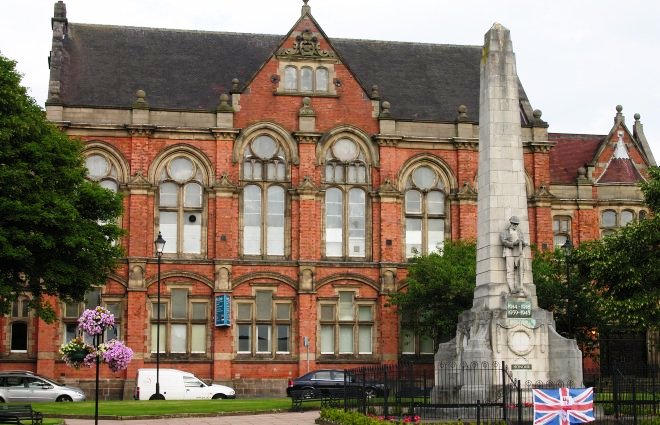
Unlisted, 1888, Robert Scrivener
Fenton Town Hall was commissioned by local industrialist, William Meath Baker, at his own expense, as part of a new civic complex for Stoke-on-Trent, which included a church, a garden square, a library, and a police station. Originally the seat of the local council, it was later turned to use as a courthouse, and remained in use as a magistrates’ court until it was relocated to Newcastle-under-Lyme in 2012. Over time, layers of partitions, plasterboard and heating ducts have hidden, but not destroyed, the grand proportions of the vaulted principal chamber, and it is hoped these can be restored. The current owner, the Ministry of Justice, has put the building up for sale, but sadly, as English Heritage has decided not to list the building, its interior, including the Minton tiling, are essentially unprotected. A ‘Save Fenton Town Hall’ campaign has been set up to protect the building and proposals are afoot to redevelop it as a community venue. The Victorian Society urges the new owners to work with the council to identify a sustainable new use that maintains the integrity of the council chamber.
Status Update / March 2026
Following a grant from Arts Council England in 2020, works were undertaken to restore and reopen the building as a community arts venue. The first phase of works saw the restoration and repair of the 3,5000 square foot ballroom, which is once again being used as a centre for dance and drama, and the installation of a new café and shop in the foyer. A second phase, supported by the city council and the Severn Trent Community Fund, focused on bringing the building up to modern sustainability and accessibility standards, involving the installation of ramps, a lift, and an air-source heat pump. The scale and situation of the town hall has enabled a variety of uses, and other parts of the building are set aside for commercial use as office, studio, and exhibition spaces.