
Giant cantilever crane in Cowes used for the production of naval warships
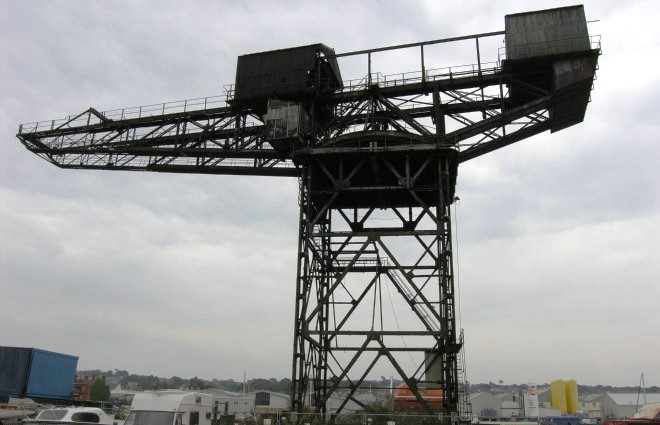
Grade II*-listed, 1911, Babcock and Wilcox
The first giant cantilever crane was constructed on the Tyne in 1909, and was listed at Grade II* in 1989, but was demolished before the end of the century. The Hammerhead Crane in Cowes still survives, however, and on account of what happened in Sunderland, it is now the oldest and most significant of its type. An eighty-ton cantilever built of cast iron with a square tower of three stages, the crane remains a prominent Isle of Wight landmark, but it has fallen out of use in recent years and is currently listed on the Historic England heritage at risk register. Corrosion is a problem, and the structure is considered to be at risk of further rapid deterioration or loss of fabric, raising the question of why the council has not stepped in to reverse its decline. With its machinery still in situ, and many original features still intact, there is the potential to restore the crane to full working order.
Status Update / March 2026
A local group, the Cowes Hammerhead Crane Trust, has been advocating for the restoration of the structure since 2006. In 2015, Historic England listed the structure as ‘at risk’ and gave the local council a £76,000 grant to pay for repairs. Following this, corroded sections in the crane’s tower were refurbished and painted. The crane is currently being redeveloped as a central feature of Marina Point, a newbuild residential development. Planning permission was approved on the condition that the developer contributed £1.7 million towards the restoration of the crane as a functioning machine.