
Bradford, Yorkshire
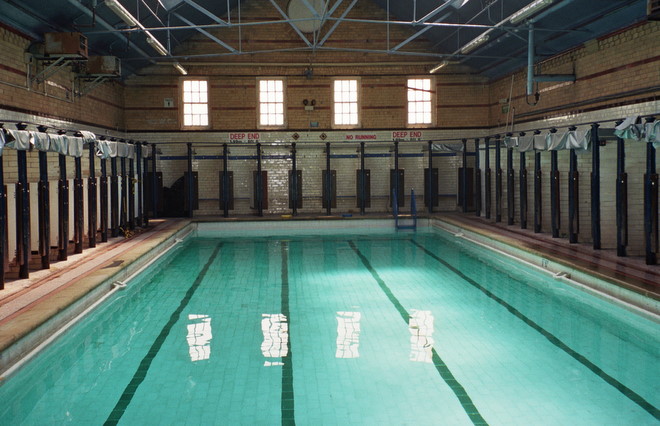
Grade II-listed, F.E.P. Edwards, 1904
Although not as grand as some listed swimming pools, what stands out at Manningham Pool is its extraordinarily intact state. The building has its original changing cubicles and the pool itself still has ceramic spittoons at regular intervals and a so-called scum channel down each side. Local campaign groups have fought hard to keep Bradford’s unique and extraordinarily intact Edwardian swimming pool open to the public, but in July Bradford Council closed Manningham Baths, and two months later drained the water from the pool. The decision was taken without any thought as to what would happen to this valuable listed building and The Victorian Society would like Bradford Council to rethink its short-term decision, or at least develop a plan for its future. Pool buildings are notoriously hard to find new uses for and the longer Manningham Pool lies empty the harder it will be to save. It is concerning to think that in the few months since it closed, it has already been broken into three times.
Ian Dungavell, Director of the The Victorian Society said ‘Nowhere else in the country could you until recently swim in a pool so close to the appearance of an “ordinary” pool of the turn of the last century. This truly remarkable survival should be used and celebrated by swimmers in Bradford, not left to rot. This rare survivor from 1904 deserves better’.
Status Update / March 2026
Following a protracted period of decline, the building was purchased by a private developer and converted into a women’s fitness centre in 2014. The award-winning restoration project involved the restoration of period features and the retention of the original swimming pool footprint, which has been incorporated into the multi-level design separating the weight training and cardio spaces. Helen Moore, the club manager at the time, said that the unique surroundings had a positive impact on new member acquisitions and reinforced the economic argument for heritage conservation.