
The Grade II-listed Pelican Works in Birmingham, built c.1868.
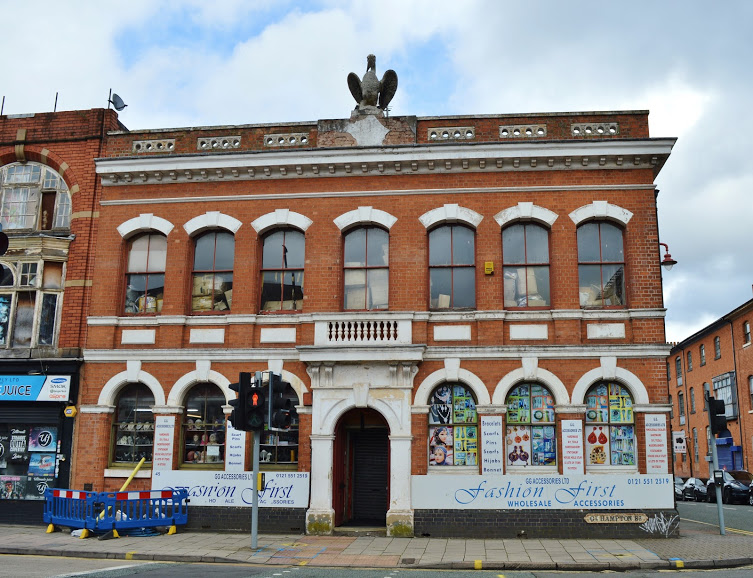
Photo: Ian Tatlock for The Victorian Society.
Grade II-listed, 1860-70, architect unknown
Pelican Works was commissioned by Thomas Wilkinson of Sheffield in 1868 for use as an electroplating works, and is notable for its contribution to the history of cutlery production in Birmingham. The frontage takes cues from Venetian palazzo and is more generous in its use of stucco than other buildings in the Jewellery Quarter conservation area. The pelican with outspread wings, placed directly above the principal entrance, is a prominent local landmark, and aided with the identification of the works from Great Hampton Street. At present, only the western half of the ground floor is occupied, and the building appear to be increasingly neglected. In May 2019 there was a serious collapse of part of the Hockley Street range, and part of the building has been demolished on safety grounds. This could be reinstated, but little seems to be being done at present to secure the future of this unusual building, and other recent collapses at historic factory buildings in the Quarter, including a tragic loss of life on another site, mean that the Pelican Works is currently at risk.
Christopher Costelloe, Director of the The Victorian Society, said: ‘The Jewellery Quarter, one of Birmingham’s most loveable areas, combines increasing development pressure with some very derelict historic buildings. The Pelican Works is a prominent symbol of the area, and it must be repaired before more of it collapses.’
Status Update / March 2026
A private developer purchased the building in 2023 with a view to converting it to residential use. Later that year, planning was granted for the delivery of 29 one and two-bedroom apartments within the existing nineteenth-century envelope. The permission includes a comprehensive refurbishment of the exterior, replacing the windows with more energy efficient like-for-like alternatives, the removal of internal staircases and structural elements, and the introduction of new partition walls and mezzanine floors.