
The currently unlisted Queensbury Tunnel in Yorkshire was built between 1874-78 by John Fraser.
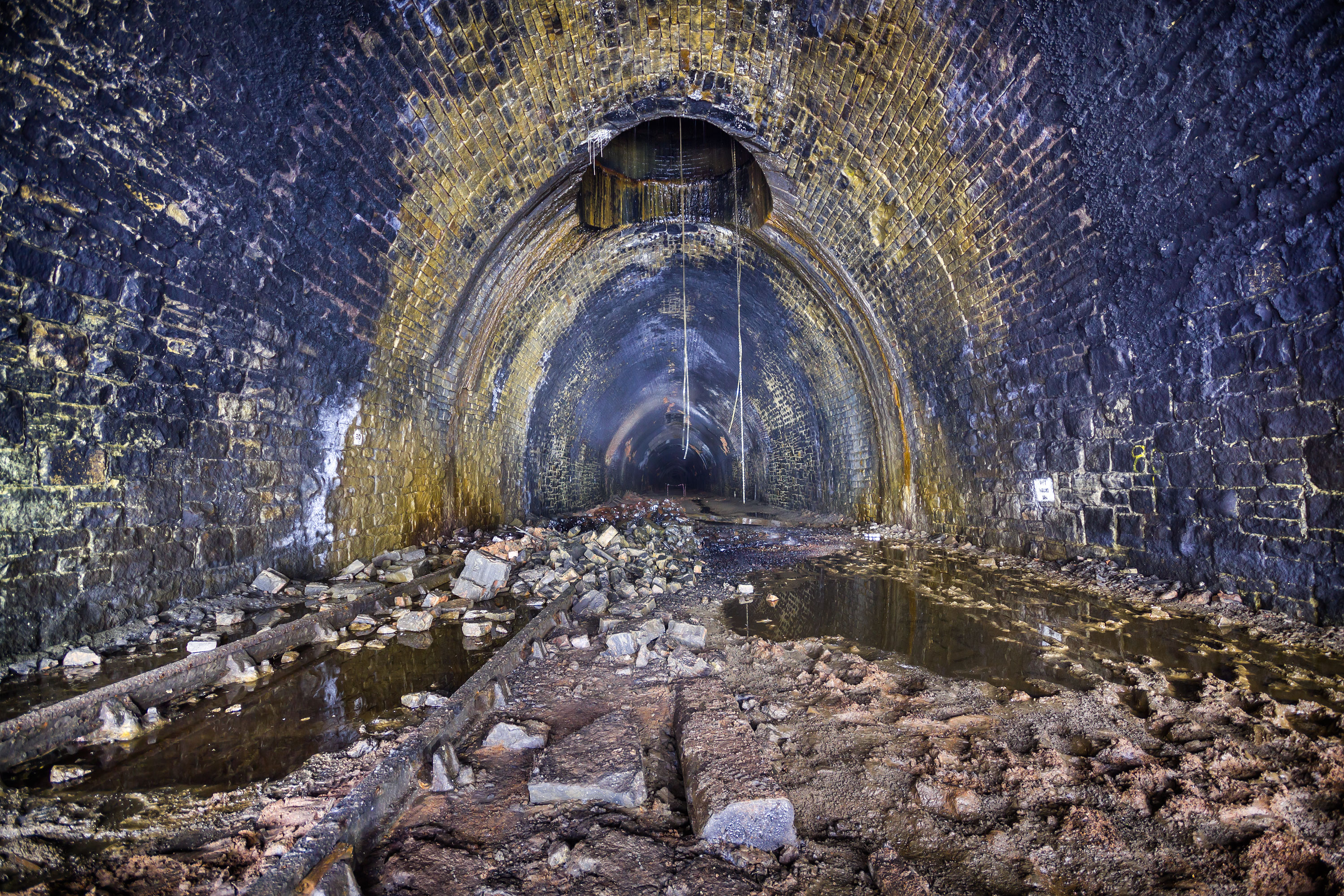
Photo Credit: Queensbury Tunnel Society.
Unlisted, 1878, John Fraser
Queensbury Tunnel is one of several major engineering feats on the Great Northern Railway, undertaken as part of a phased expansion through the Pennines, where the terrain rises steeply to a plateau of 1,000 feet. The longest on the company’s network at the time of its opening, running to a length of approximately 1.4 miles, the tunnel was commissioned to connect Halifax with Bradford and Keighley on the so-called Queensbury lines. Although passenger traffic declined due to competition from road transport in the 1950s, freight remained buoyant, and the decision to axe the route came in 1956 came as a surprise to local haulage companies. The maintenance costs were cited as the reason, and in its current deteriorated state, largely abandoned and flooded with water, this remains a cause for concern. At the time of writing in 2019, the tunnel lies at the centre of a heated debate between campaigners, with the Queensbury Tunnel Society campaigning to have the tunnel restored as a cycle path, and the Department for Transport wants to fill in sections of the tunnel with concrete and then leave it to collapse. The Victorian Society’s position is that it would be better to preserve the tunnel as a trans-Pennine link, than to allow an important piece of industrial history to disappear forever.
Christopher Costelloe, Director of the The Victorian Society, said: ‘Queensbury Tunnel could be the heart of a new transport revolution, bringing cyclists and tourists to this part of Yorkshire. If it is filled-in this irreplaceable asset will be lost for ever. Bath’s Two Tunnels cycleway has been a triumphant success and there is no reason why Yorkshire – now the beating heart of British cycling – couldn’t do the same.’
Status Update / March 2026
Shortly after appearing on our list in 2019, plans emerged for the redevelopment of the tunnel as a new cycle route. The visualisations provided by the architect depict the tunnel with a bespoke lighting system and rest areas on the assumption that it will serve a range of leisure and personal transport uses. In July 2025, however, the government concluded that the scheme would be too expensive, at a cost of £22 million, and committed to filling the tunnel with concrete at a cost of £7.5 million. The engineering consultancy, AECOM, said the work would have cost £6.9 million and that every £1 spent would return £3 in social, economic, and tourism benefits.