
Widnes, Cheshire
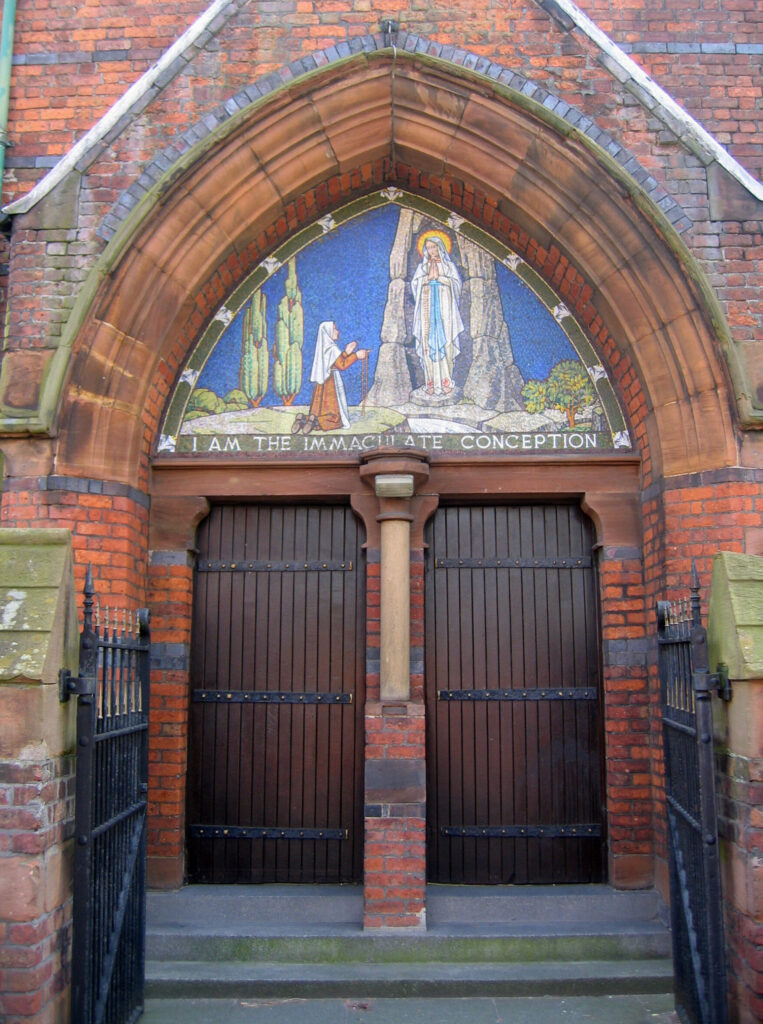
Peter I. Vardy, Public Domain
Grade II-listed, 1864, E.W. Pugin
St. Marie’s Church is of special interest as an example of E.W. Pugin’s ‘industrial’ churches, which were intended to provide accessible places of worship for communities centred around heavy industries and trades. It was modelled with restraint and simplicity externally, partly to minimise building costs, and is arranged across a single-cell plan, with the nave and apse beneath a single roof structure and lean-to aisles to either side. Yet internally, it surprises with a comprehensive interior design system, the focal point of which is a High Victorian altar and reredos which dominates the apse of the building.
The Roman Catholic church was built between 1862 and 1865, in response to significant demographic changes in Widnes, attributed to the large number of Irish immigrants coming to work in chemical factories. Its construction was funded by its soon-to-be congregation, and it retains a close relationship with the nearby St. Marie’s Junior School, despite the demolition of the terraced streets between them. The church, unlike the town, is little altered, and remains significant as a particularly well-preserved example of a Catholic church designed by Pugin at the height of his career.
With so many churches suffering from dwindling congregations and punitive maintenance costs, it is particularly frustrating to see a church with an enthusiastic community around it which is forbidden to use the building. The building would have been demolished in early 2007 but for an eleventh hour to list it at Grade II, and whilst the move certainly halted the demolition plans, it did nothing to alter the Roman Catholic Archdiocese of Liverpool’s resolve to lock the building and walk away. With the Catholic population of Widnes on the increase thanks to the growth of the local eastern European community, many groups, including the local council, are anxious for the building to be reopened or, at the very least, given an alternative use. So far the Archdiocese remains intransigent.
Status Update / March 2026
St. Helens Voluntary Action took control of the church in 2012, and after securing funding from the National Lottery Heritage Fund later that year, they moved forward with a comprehensive restoration programme. From 2011 to 2014, they worked with a number of partner organisations on the renovation of the material fabric and oversaw the redevelopment of the building as heritage centre and office space. A local heritage group now organises regular events and activities in the building.