
St Joseph’s Seminary in Upholland, Lancashire needs new purpose to avoid decaying further
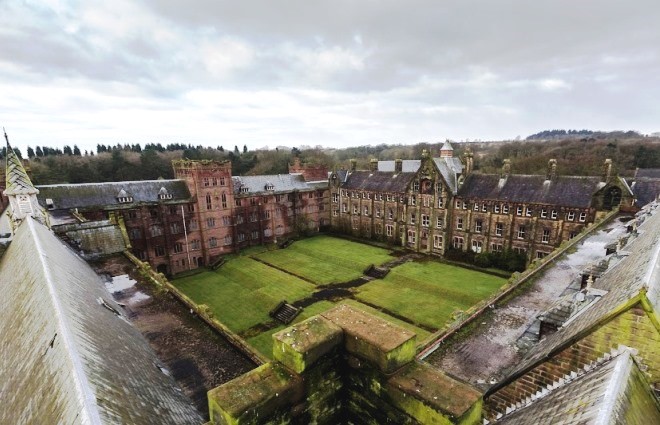
Grade II-listed, 1880-83, J O’Byrne; extended 1921-8, Pugin and Pugin
Described in The Tablet as ‘one of the glories of Catholicism in England’, St. Joseph’s Seminary was constructed at the expense of the Roman Catholic church, at what was then the geographical centre of the Roman Catholic Diocese of Liverpool, and on a monumental scale. Conceived by its architect, J. O’Byrne, as a vast Gothic quadrangle, ‘nearly an acre in size, considerably larger than any of the former quads at Oxford and Cambridge’, the building signalled the revival of Catholic education in an Anglican country, and bears witness to a time when many young men wanted to train to become priests. The number of applicants gradually increased with time, and an extension was eventually required, built by Pugin and Pugin in the practice’s characteristic Gothic style; but this was not to last, and when this trend was reversed in the 1960s, the seminary began to decline. The building was converted for use as a boys’ boarding school in 1979, and remained in this use until the 1990s, when it was abandoned and its association with religious education formally ceased. At the time of writing, the building remains vacant, and in a derelict state, at risk of further rapid deterioration. It has become a popular location for ‘urban explorers’, some of whom have vandalised the interior.
The Victorian Society Director, Christopher Costelloe, said: ‘Lancashire and the north west has more buildings on our Top Ten than anywhere else in the country. But for the first time we have no entries for London or the South East. We simply got far more nominations from areas like Lancashire. This perhaps reflects the vastly different financial climate for development. But whatever the reason, I hope inclusion in the Top Ten will spur local authorities and owners to urgently find a way to bring these buildings back into use. At a time when there has been much discussion of creating a northern power house this is more important than ever. Retaining historic buildings like those in the Top Ten is vital to maintaining local identity and creating places in which people want to invest, live and work.’
Status Update / March 2026
Following a protracted period of decline, the building was demolished in phases between 2022 and 2023 at a cost of £800,000. The modern extensions were demolished initially and, once structural defects were confirmed, its heritage assets were tragically broken into pieces, with much of the old stone was cleaned and salvaged for reuse.