


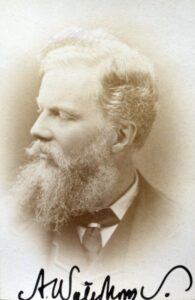
Alfred Waterhouse is a Victorian architect of national importance and of particular interest to the Manchester Group because of the many fine buildings he designed in the city, some of which were saved from destruction by the Group’s intervention. As work on renovating Manchester Town Hall draws to a close, it is a fitting moment to revisit his career and be reminded of his finest achievements in a talk given by Alexandra Fairclough, a member of the Manchester Group committee and a specialist in architectural heritage.
Alfred Waterhouse was a prominent Victorian architect known for his contributions to Gothic Revival architecture. He designed several notable buildings including Manchester Town Hall and the Natural History Museum in London. He was particularly active in designing civic and educational buildings including Gonville and Caius College Cambridge and University College Hospital, London. His style is characterised by the use of terracotta and brick, often with decorative ironwork and exposed metal structure. His work is celebrated for its scale, intricacy and the ability to create complex buildings on difficult sites. He was elected a Fellow of the RIBA in 1861.
This talk will provide an appropriate lead-in to the biennial Waterhouse Lecture to be given in April by Nicholas Olsberg, biographer of William Butterfield.
Alexandra Fairclough is an architectural historian and heritage specialist. She studied her Masters in Architectural Conservation, Vernacular and Historical Studies at Manchester University School of Architecture. She is also a qualified tour guide and specialises in historical and architectural tours. She has written many papers that have been published in professional journals and she is writing her first book on heritage.