

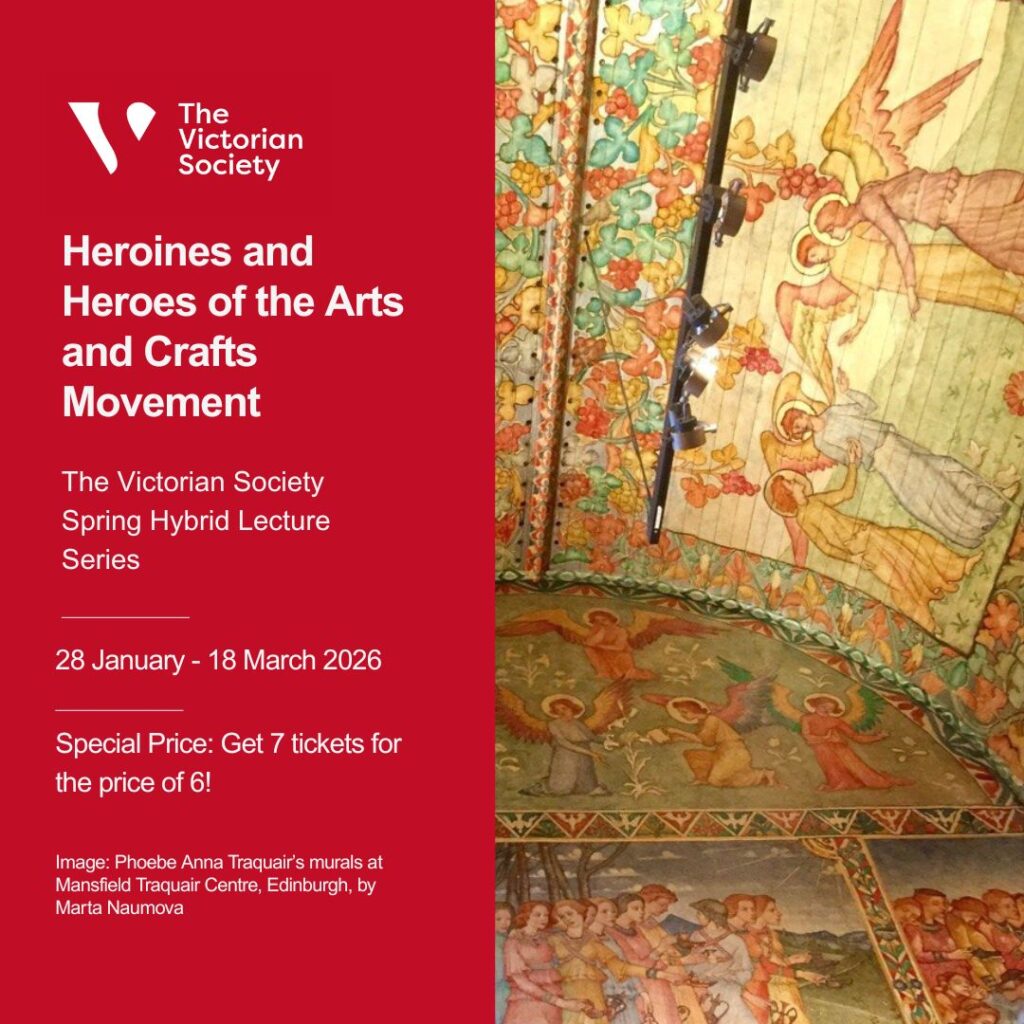
Photo and graphic: Marta Naumova
The Victorian Society’s Hybrid Spring Lecture Series: 28th January – 18 March 2026
Join us from the 28 January for our next lecture series, excitingly our first in-person series for a number of years. The lectures will take place at NYU London, 265 Strand, London and will be live-streamed and will also be available as recordings. The subject for Spring 2026 is the Arts and Crafts Movement. Our speakers will be drawing on a large amount of new research, much of which is highlighting the often-neglected role played by women in a Movement that remains of direct relevance and a source of inspiration to architects, artists and designers today.
Subjects include: Philip Webb, Gertrude Jekyll, Edwin Lutyens, Phoebe Anna Traquair, Charles Rennie Mackintosh & Margaret Macdonald, May Morris and Christopher Whall.
Tickets can be purchased for single lectures or for the entire series.
Special Offer: Get all 7 lectures for the price of 6 – both online and in person.
Philip Webb by Max Donnelly
Wed 28 January, 6:30 pm – 8:00 pm
Max Donnelly, Curator of Furniture 1800–1915 at the Victoria and Albert Museum, will discuss Webb’s works as a designer of domestic interiors, drawing on the wealth of new biographical information about the architect in his collected letters, published by John Aplin in 2016, and on the research he has carried out for a chapter on Webb’s designs for interior decoration in the catalogue for an exhibition on Webb to be held at the Bard Graduate Center, New York.
Gertrude Jekyll: ‘Artist Gardener Craftswoman’ by Dr Caroline Ikin
Wed 4 February, 6:30 pm – 8:00 pm
As the home of celebrated gardener Gertrude Jekyll (1843-1932), Munstead Wood holds deep significance as the place where her ideal of the ‘artist-gardener’ achieved complete expression. A trained artist, Jekyll also applied her creativity to the decorative arts, design and collecting, and was a skilled craftswoman. Recent research on the interiors and furnishing of Munstead Wood, now in the care of the National Trust, offers insight into the collaboration between Jekyll and her architect Edwin Lutyens to create a domestic space shaped around arts and crafts ideals. Dr Caroline Ikin is Curator at the National Trust for Munstead Wood. She has previously worked in museums and for the Gardens Trust and her research interest lies broadly in nineteenth century art, architecture and gardens.
From Surrey to New Delhi: Lutyens and the Arts & Crafts Movement by Clive Aslet
Wed 11 February, 6:30 pm – 8:00 pm
Growing up in the Surrey village of Thursley, Sir Edwin Lutyens didn’t know it, but he was to follow in the footsteps of greats like John Ruskin, William Morris and Philip Webb in the tradition of British pride in craftsmanship that was to define the Arts and Crafts movement at the end of the 19th and early 20th centuries. Home educated and sickly, a chance meeting with Gertrude Jekyll would turn this young architect into THE architect of the rich elite of Surrey, London and beyond. Their partnership and his talent for charming his clients would see Lutyens move in ever greater circles and culminated in large scale projects of New Delhi and Liverpool Metropolitan Cathedral – outwardly classical, elements of these monoliths can be traced back to designs found at Folly Farm, Marsh Court and Castle Drogo. Clive Aslet is an award-winning writer and Visiting Professor of Architecture at the University of Cambridge. Clive has published more than thirty books on architecture and British culture. His most recent publications include Sir Edwin Lutyens: Britain’s Greatest Architect? (2024). For many years Clive was Editor of the magazine Country Life.
Phoebe Anna Traquair by Dr Elizabeth Cumming
Wed 25 February, 6:30 pm – 8:00 pm
‘A woman the size of a fly’: Louis Davis’s 1902 comment to his friend Robert Lorimer gives no idea of the sheer ambition and many achievements of Phoebe Anna Traquair (1852–1936). Born and educated in Ireland, she settled with her Scottish husband to Edinburgh, where she became involved in the city’s social art movement, painting murals in tiny and vast buildings and teaching design from the 1880s. She produced some of Britain’s most remarkable embroideries and illuminated manuscripts, packed with colour and imagination. Our speaker, Dr Elizabeth Cumming, has documented Traquair’s life and art for nearly half a century, including most recently Phoebe Anna Traquair for the National Galleries of Scotland in 2022.
Charles Rennie Mackintosh and Margaret Macdonald by Robyne Calvert
Wed 4 March, 6:30 pm – 8:00 pm
For all his fame, more myths cling to Charles Rennie Mackintosh (1868–1928) and his significance as a designer than to almost any other architect of the Arts and Crafts movement. Many centre on his marriage in 1900 to the artist Margaret Macdonald (1864–1933), with whom he was then collaborating on the design of the Ladies Luncheon Room at Miss Cranston’s Tearooms at Ingram Street, Glasgow. ‘You are half if not three quarters in all my architectural work’, wrote Mackintosh to his wife, but how true was that? Their partnership will be analysed by Robyne Calvert, the author of The Mack: Charles Rennie Mackintosh and the Glasgow School of Art, published by Yale University Press in 2024.
May Morris and the Art of Embroidery by Dr Lynn Hulse
Wed 11 March, 6:30 pm – 8:00 pm
May Morris described design as ‘the very soul and essence of beautiful embroidery’ and ranked it chief among the four elements that make a piece of needlework truly ‘artistic’. Drawing on her substantial corpus of designs in the Ashmolean Museum, Lynn Hulse will explore May’s approach to translating a sketched idea into a finished piece of embroidery, contextualising her work within the artistic developments of needle-art that were taking place in the years leading up to and during her lifetime. Dr Lynn Hulse is a textile scholar and practitioner, specialising in embroidered furnishings of the Aesthetic and Arts and Crafts movements. She is the author of several publications on decorative needlework and editor of May Morris: Art & Life (2017). Her most recent book May Morris Designs was published by the Ashmolean Museum in August 2025.
Christopher Whall by Peter Cormack
Wed 18 March, 6:30 pm – 8:00 pm
When windows designed by Christopher Whall (1849–1924) were shown at the Arts and Crafts Exhibition Society in London in 1888 they were immediately recognised as a break-through. Whall changed for ever the direction of the finest stained glass in Britain, thanks to his mastery of not only design but also every stage of its manufacture to create windows in which sumptuous colours were combined with thickly textured ‘slab’ glasses and bold leading patterns. Whall’s achievement will be discussed by Peter Cormack, a noted scholar of post-medieval British and American stained glass, William Morris and the Arts and Crafts Movement, whose classic study Arts & Crafts Stained Glass, published by Yale University Press in 2015 was the first book to do Whall and his legacy full justice.
In-person at NYU London, 265 Strand, London WC2R 1BH. (All tickets must be booked in advance).
Time: Doors open at 6:15 pm and the lecture starts at 6:30 pm.
Refreshments will be available after the lecture (not included in the ticket prices).
Tube: Charing Cross, Waterloo or Temple.
Prices: In-person tickets per lecture: £11 for members/ £15 for non-members. Online tickets per lecture : £6 for members/ £8 for non-members. The complete series of 7 lectures for 6: in-person tickets: £66 for members/£90 for non-members or Online tickets: £36 for members/ £48 for non-members.
Members of the Young Victorians get 50% off tickets for this series.
Book here to attend In-person or Online.