

Online Autumn Lecture Series 2026 Including One In-person Lecture
New Bearings in Victorian Architecture
Our autumn lecture series celebrates the publication of the most ambitious overview of Victorian architecture in a generation.
In his new volume for the Oxford History of Art, Victorian Architecture, G.A. Bremner, Professor of Architectural History at the University of Edinburgh, has broken with the tradition of surveys based on building typologies or style. Instead, he has approached this protean subject in a series of thematic chapters that highlight the way architecture is key to understanding Victorian debates about such issues as technology, urbanism, modernity, government, empire, faith, domesticity and consumerism. A fundamental aspect of his analysis is its consistent emphasis on the global nature of Victorian architecture and its place in the greater Britain forged by the country’s colonial expansion.
TO BOOK THE COMPLETE SERIES INCLUDING IN-PERSON LECTURE, PLEASE FOLLOW THIS LINK.
Lecture schedule:
Online Autumn Lecture: 1
New Bearings in Victorian Architecture: Michael Hall Interviews Prof. Alex Bremner
Wednesday 21st October 2026, 6:30 pm – 8:00 pm
The series begins with Michael Hall interviewing Professor G.A. Bremner about the ideas that underpin his book and the ways that it represents new ways of thinking about Victorian buildings.
A regular lecturer to the Victorian Society, Professor Bremner is the author of Imperial Gothic: Religious Architecture and High Anglican Culture in the British Empire c.1840-70, published by Yale University Press in 2013, which received the Alice Davis Hitchcock Medallion for 2013 from the Society of Architectural Historians of Great Britain, and the William M. B. Berger Prize for British Art History in 2014, and Building Greater Britain: Architecture, Imperialism, and the Edwardian Baroque Revival, c.1885–1920, published by Yale in 2022.
Online Autumn Lecture: 2
Rethinking Euston Arch: Fossil Fuels, Architecture and the Scrambling of History by Aleksandr Bierig
Tuesday 3 November, 6:30 pm – 8:00 pm
This talk will provide a brief overview of questions that arise when we consider the history of Victorian architecture through the lens of fossil fuels, before turning to the reassessment of a single, well-known case: Euston Station in London, the first major metropolitan railway terminus in the world (and signal monument in the history of the Victorian Society). Tracing a set of architects, writers, artists, historians, and others who grappled with Euston’s over-scaled and unsettled form, it will aim to offer a case study in how considering architecture and energy, together, presents opportunities to read familiar histories in new ways.
Aleksandr Bierig is an Assistant Professor at the University of Toronto.
Online Autumn Lecture: 3
The Englishness of English Churches in Europe by James Bettley
Tuesday 10 November, 6:30 pm – 8:00 pm
By 1914 there were nearly 300 Anglican churches across mainland Europe, the vast majority built since 1815. They were primarily erected to meet the needs of British residents, tourists and workers, but in many cases, and depending on their location, they also promoted Protestantism, the Church of England, Great Britain, British architecture and design, and the British way of life. Generally welcomed, in certain places and at certain times they were also targets of political and religious hostility. This talk explores the diverse nature of this often overlooked body of churches. James Bettley is the author of English Churches in Europe: An Architectural and Social History, published by John Hudson this year.
Online Autumn Lecture: 4
Women and the Re-making of Edinburgh’s Old Town in the late-Victorian and Edwardian Era by Elizabeth Darling
Tuesday 17 November, 6:30 pm – 8:00 pm
This talk explores the way that women of all classes sought to re-make the urban environment in Edinburgh’s Old Town between the 1880s and the 1910s. With a particular focus on the Canongate (and an excursion to Charlotte Square in the New Town), it will discuss the way women made interventions into existing buildings and spaces, which resulted in transformed environments that were intended to improve and enhance the lives of the Old Town community. Elizabeth Darling is an independent architectural historian. Her publications include Women and the Making of Built Space in England, 1870–1950 (2007), co-edited with Lesley Whitworth, and Suffragette City, Women, Politics, and the Built Environment (2020; co-edited with Nathaniel Walker.
Online Autumn Lecture: 5
Imperial Logistics: Victorian Architecture and Infrastructure by Matthew Wells
Wednesday 25 November, 6:30 pm – 8:00 pm
During the nineteenth century, the British empire depended upon the movement of people, commodities, and information across increasingly large distances. This lecture explores the role that architecture played in organising these flows. Moving from Britain to sites across the world, we will examine buildings and infrastructure including docks, warehouses, railway stations, telegraph offices, and government buildings. Rather than treating architecture simply as a representation of empire, the lecture considers how buildings formed part of the material systems through which imperial and commercial expansion operated. Matthew Wells is Senior Lecturer in Architectural Studies at the University of Manchester and Belcher Visiting Fellow in Victorian Studies at St Hugh’s College, Oxford
Online Autumn Lecture: 6
The Crimea Memorial Church in Constantinople, from Competition to Completion by Neil Jackson
Tuesday 1 December, 6:30 pm – 8:00 pm
The building of the Crimea Memorial Church in Constantinople, from the design competition of 1856 to the building’s completion in 1868, is one of the more tragic stories of Victorian architecture: how William Burges’s brilliant design was whittled away, its architect sacked, and how George Edmund Street was called in to replace him. Using documentary evidence from the Bodleian Library and the RIBA Drawings Collection, this lecture follows the course of the design’s retrogression from a large, richly ornate vision to something little more than an English parish church on a cramped site in the city’s Pera district. Neil Jackson is Emeritus Professor of Architecture, University of Liverpool. In 2027 he will publish Josiah Conder: The Father of Modern Japanese Architecture (with Robert Morton). Conder worked for Burges.
Online Autumn Lecture: 7
Marble in the Making: From Quarry to Building in Victorian Ireland by Louise Caulfield
Wednesday 9 December, 6:30 pm – 8:00 pm
This talk will discuss the use of native marble in buildings in Victorian Ireland, from the development of its quarries and expansion of the industry to the skilled makers who transformed stone into architectural decoration. Drawing on her forthcoming book, Louise Caulfield explores its lithologies, extraction and fabrication, alongside the people, places and buildings that shaped Ireland’s remarkable marble heritage. A geologist with a special interest in the interplay between geology and architecture, Dr Louise Caulfield is Research Fellow of the STONEBUILT Ireland project at Trinity College Dublin. Her book Marble in the Making: From Quarry to Building in Victorian Ireland will be published by UCL Press in January.
All attendees will be sent a recording of the talk.
This event helps raise funds for The Victorian Society – the only charity dedicated to fighting for our Victorian and Edwardian heritage. Join us today and safeguard our unique cultural heritage for future generations! For further information, click here.
The Victorian Society is an IHBC recognised CPD provider.
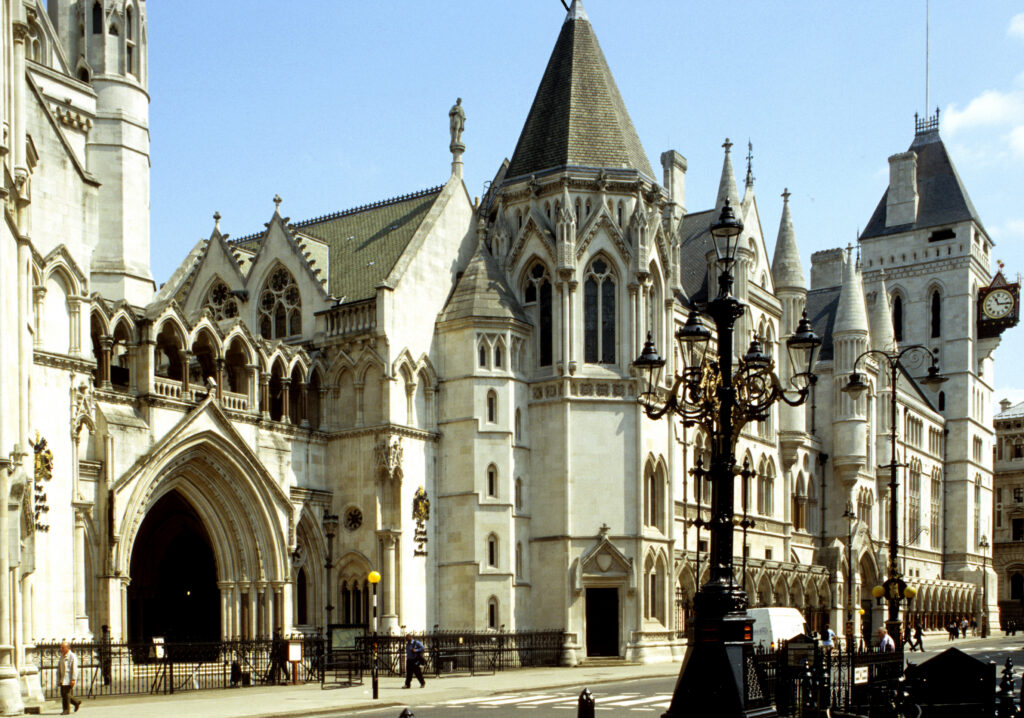
Image: Royal Courts of Justice. Photo by Neil Jackson.