

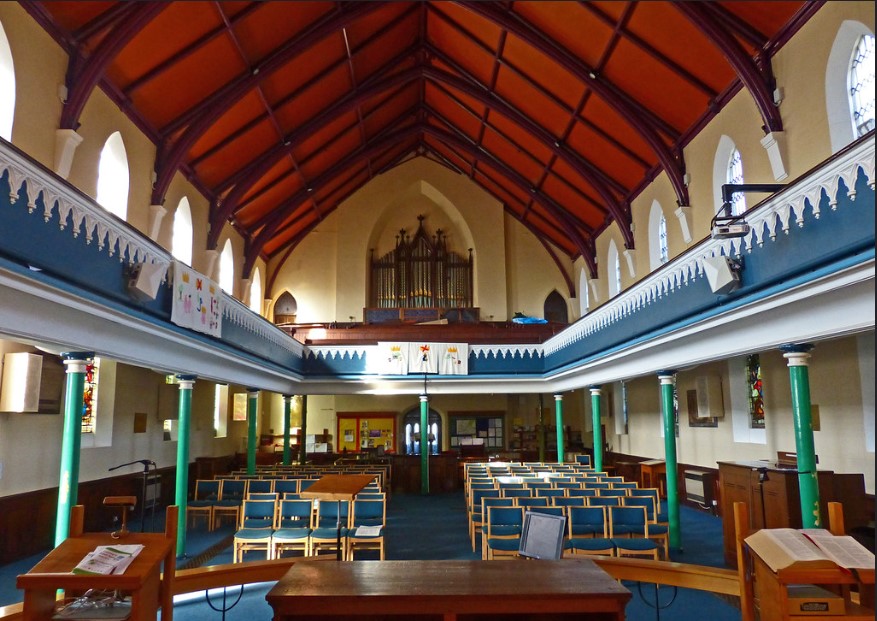
The interior of Holy Trinity in West Bromwich. Photo: Tudor Barlow
The Victorian Society is delighted that following an application, made by our West Midlands and Birmingham regional group, Holy Trinity in West Bromwich has been added to the list of nationally significant buildings at Grade II. The Society applied for the listing in order to preserve this unspoilt church from reordering which would destroy its original design and internal features.
Holy Trinity, designed in the Early English Gothic style by well-known architect Samuel Whitfield Daukes is best known for his work in Gloucester, Cheltenham, and London. Built in 1840-41, Holy Trinity has a tall west turreted tower that is visible landmark locally. The church reflects the need in the Victorian period to house a rapidly growing urban congregation for services focussed on preaching from a pulpit but allowing for occasional communion. The church has furnishings, stained glass and memorials made by local firms that were nationally known for their ecclesiastical work. The layout and decoration of the church place it firmly in the evangelical or ‘Low Church’ tradition at a time when there were great tensions in the Church of England over how the liturgy was delivered to the people.
Holy Trinity’s construction was funded by the town’s rapidly expanding population, so it reflected the monies raised from worshippers. The numbers of seats reflect the Church of England’s efforts to retain its congregation which was being decreased by the rising popularity of non-conformist denominations. Holy Trinity’s preaching, emphasised the congregation being able see and hear the vicar in the pulpit. Daukes design for the church is in a simplified Gothic style that was popular in Anglican churches to distinguish them from Nonconformist chapels. The nave with a gallery on three sides allowed room for a large congregation with excellent views of the pulpit. This follows late Georgian styles of Anglican church design. Although constructed in brick the church mimics the stone buttresses and pinnacles of early English medieval churches. The tower is its dominant feature. The furnishings retain the church’s history.
The Society thank the Secretary of State for Digital, Culture, Media and Sport, and Historic England for listing this building for its architectural and historic significance.
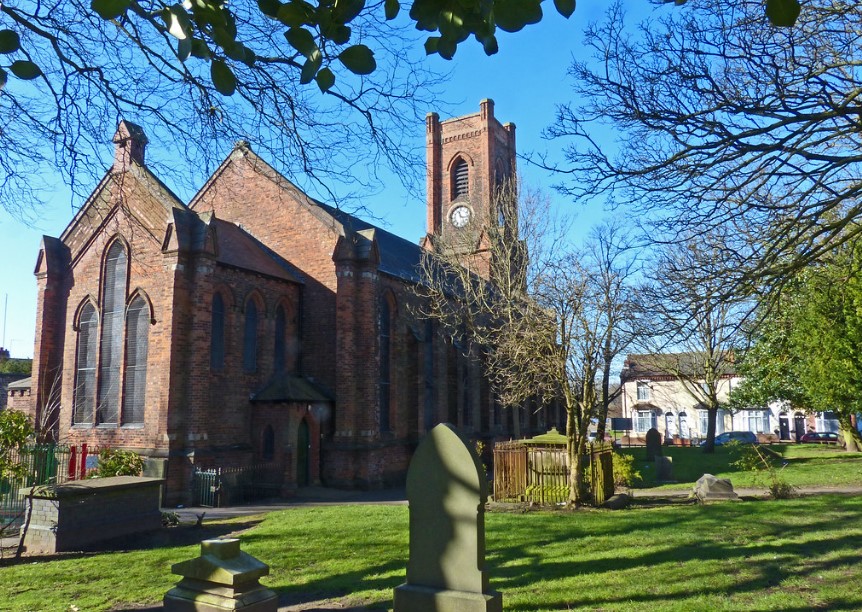
The exterior of Holy Trinity West Bromwich. Photo: Tudor Barlow