
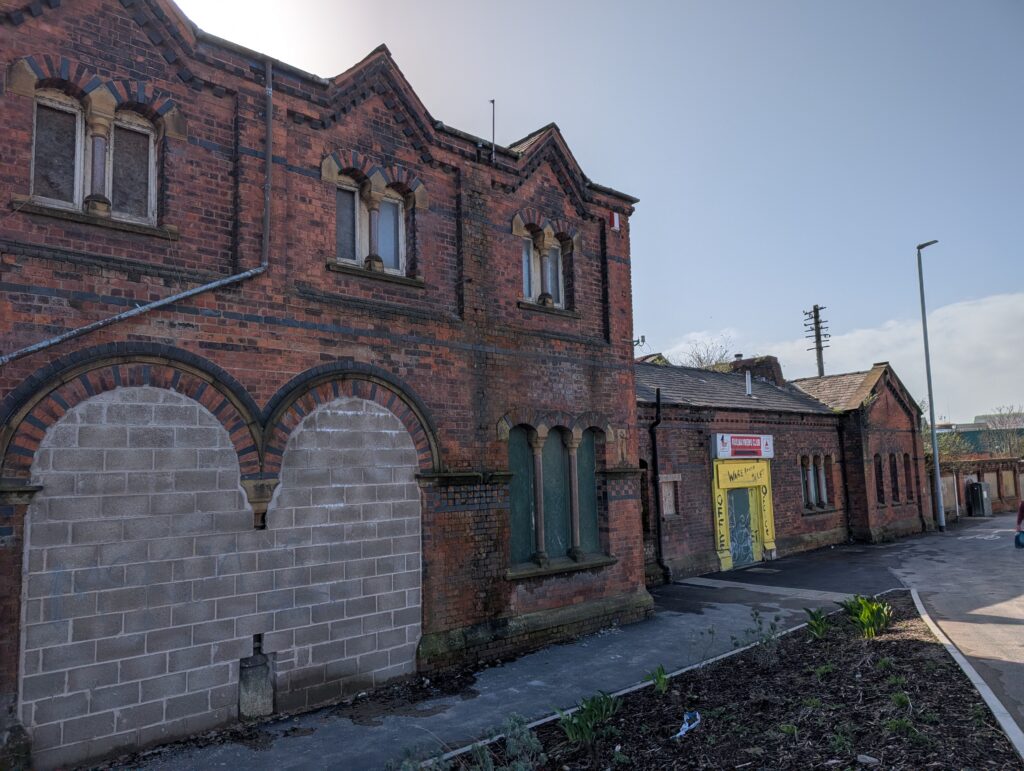
Former Strand Railway Station and Railway Men’s Club, Barrow-in-Furness. Photo: Thomas Ollivier/The Victorian Society
Added to the Victorian Society’s Top Ten Endangered Buildings list in 2026
Grade II, Architect, E. G. Paley, 1863
The former Strand Railway Station in Barrow-in-Furness is a significant survivor from the earliest phase of the town’s rapid industrial growth. Once at the heart of a transforming settlement, it now stands vacant and deteriorating, its future uncertain.
Built in 1863, the station served what was then a small but fast-expanding community. Within a few decades, Barrow would be transformed into a major industrial and maritime centre, driven by the extraction of iron ore and the development of rail and dock infrastructure. By 1856, 464,823 tons of iron ore were raised in Furness, of which 445,013 tons were transported via the Furness Railway and shipped from Barrow. The opening of Devonshire Dock in 1867 further accelerated this growth, prompting Prime Minister William Ewart Gladstone to predict that Barrow would become “another Liverpool”.
The Strand station stood at the centre of this transformation, forming part of a wider complex that included the offices of the Furness Railway Company and associated engineering works. However, its role as a passenger station was relatively short-lived. The original railway alignment required trains to terminate at Barrow and then reverse out to continue their journey, an arrangement that quickly proved inefficient. In 1882, a new through-route and Barrow Central station were opened, and the Strand site was relegated to secondary uses.
Rather than being demolished, the building was adapted. Contemporary reports describe plans to convert it into a reading room and library for railway employees, with parts of the site also used as a drill hall. This marked the beginning of a long period of reuse, reflecting Victorian ideals of improvement and provision for workers.
By the early 20th century, the site had become the Railwaymen’s Club, aligned with the ethos of the Mechanics’ Institute movement. It provided educational and social facilities and remained a focal point for the community for over a century. Its later history reflected changing social habits: alcohol was only introduced in 1947, and by the 1990s the club faced financial pressures, narrowly avoiding closure. It finally closed in 2008 after 101 years of operation.
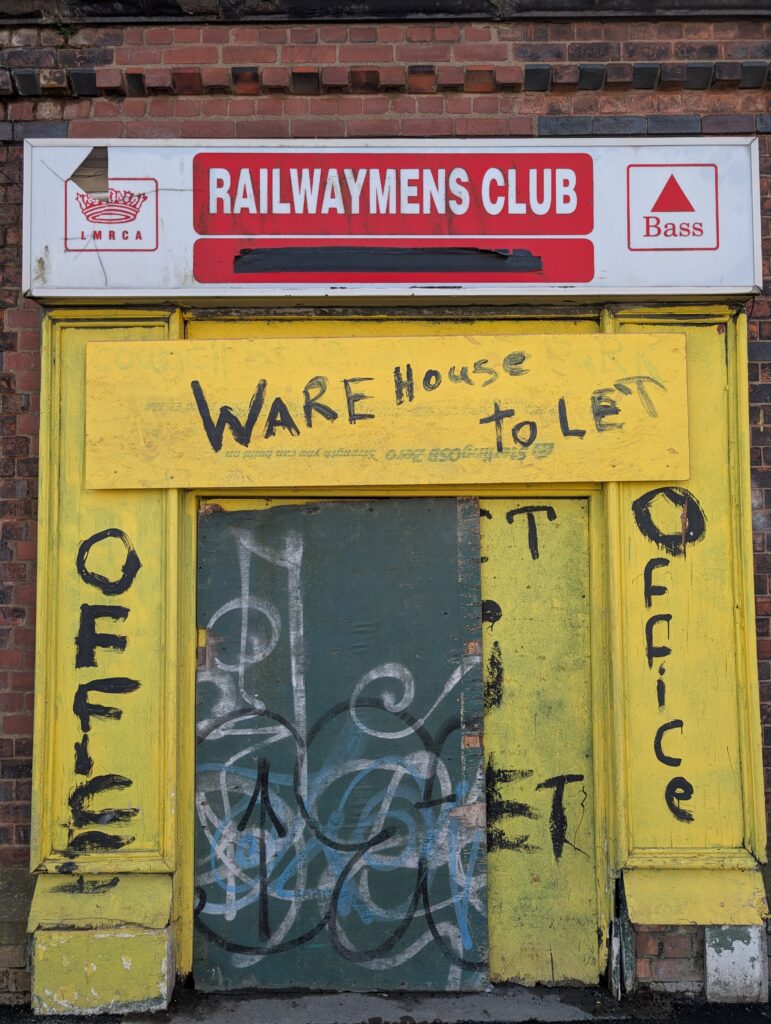
The Railwaymen’s Club Barrow-in-Furness entrance Photo: Thomas Ollivier/The Victorian Society
Today, the building is owned by an absentee landlord and is in visible decline. Once part of the bustling centre of Barrow’s industrial and civic life, it now stands neglected, with no clear plan for its future. Without intervention, further deterioration is inevitable.
The Victorian Society is calling for the building to be brought back into active use through sensitive restoration. As a robust and adaptable structure that has already supported a wide range of functions, it presents a clear opportunity for regeneration. This is a building that has continually evolved to meet the needs of the town, and can do so again.
Griff Rhys Jones, Victorian Society President, said: ”I love a railway station. The Victorians were almost at their best building their handsome, accessible, useable, human-scaled transport network, on lines that changed the world. Here is an example of a good building that has already been repurposed. This is the green option. Use it again. Don’t let it fall into decay.”
James Hughes, Director of the Victorian Society, said: “This building is closely tied to Barrow’s remarkable rise as an industrial powerhouse. Its history of adaptation shows exactly the kind of sustainable reuse we should be championing today. What is needed now is a clear commitment to securing its future before further deterioration takes hold.”
The full Top Ten Endangered Buildings list for 2026 of Victorian and Edwardian buildings, and the archive of our previous Top Ten lists, can be viewed here.
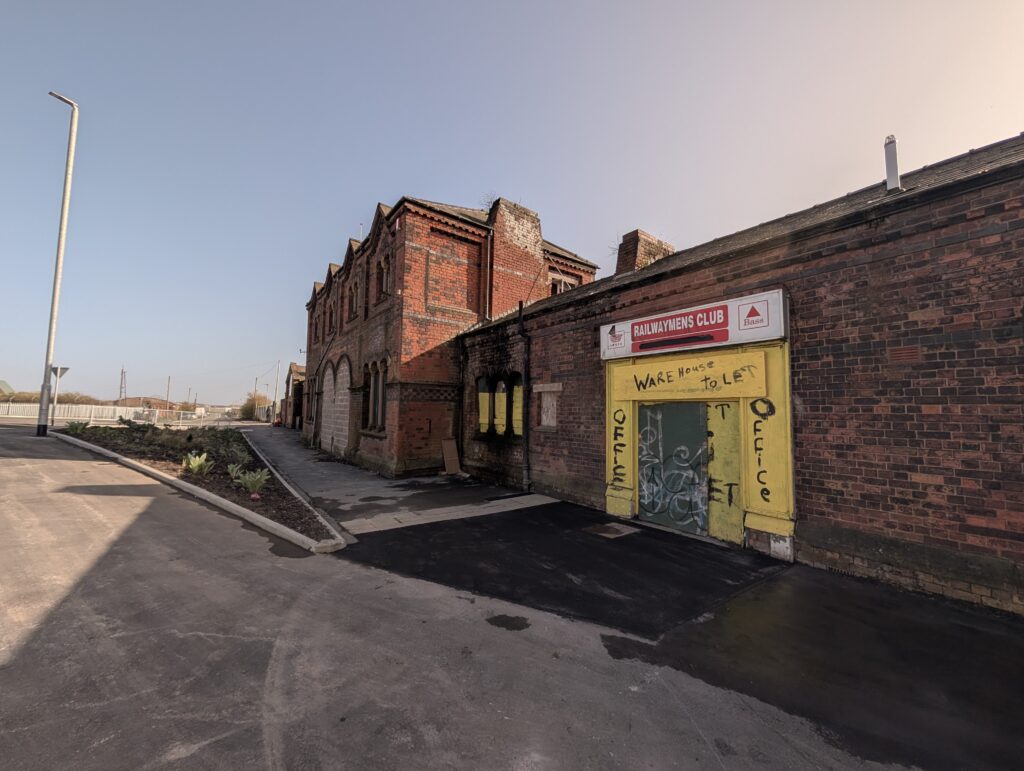
The Railwaymen’s Club former entrance. Photo: Thomas Ollivier/The Victorian Society