
Pembroke Dock, Pembrokeshire
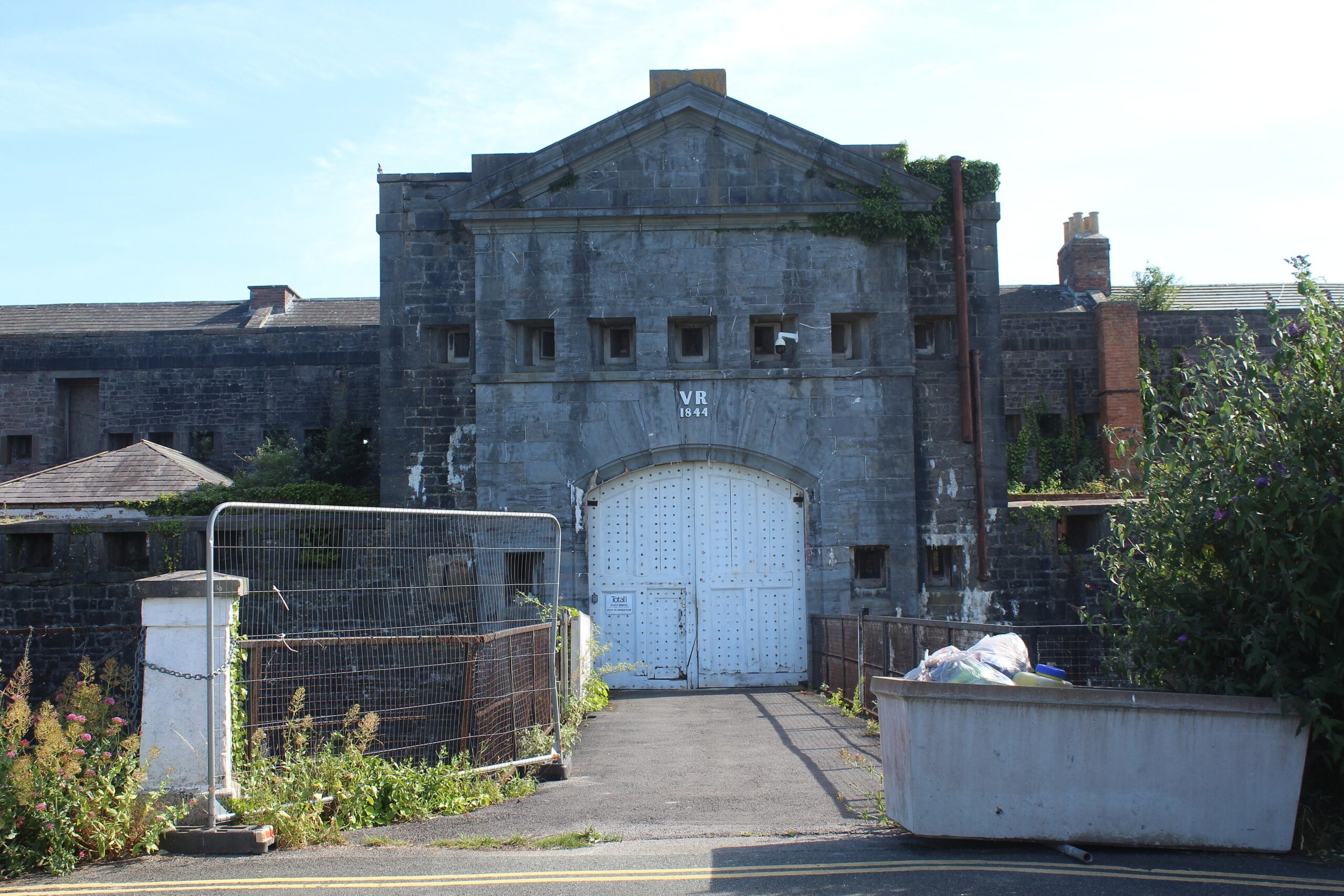
Defensible Barracks by M J Roscoe, CC BY-SA 2.0
Grade II*-listed, 1842-46, Captain Farris
The former Defensible Barracks at Pembroke Dock were laid out by the superintendent engineer Captain Farris in 1842, and constructed over the course of four years at a cost of nearly £40,000. Originally built to house the dockyards’ garrison of the Royal Marines, it subsequently served as the headquarters of the 9th Welsh Garrison Artillery Brigade, the No. 26 Pembrokeshire Fire Command, and the Pembroke Royal Garrison Artillery, before being converted for use as a training centre after the Second World War. Accessed via a fixed steel bridge which replaced the original drawbridge, the twenty-sided stone fort occupies a prominent position on a hill overlooking the dockyard and is surrounded by a dry moat 16 feet deep and 42 feet wide.
The barracks is in the form of a square bastion trace with four, two-storey ranges surrounding a parading ground, and is probably the last example of its type anywhere in Europe. The layout dates from sixteenth-century Italy, and was adopted in this instance as a compromise, to accommodate the maximum number of troops whilst still adequately fortifying this strategic location on the west coast of Wales. The gatehouse has a pedimented ashlar front with musketry holes, and a the date stone inscribed ‘VE 1844’, which seemingly contradicts its Palladian appearance. The design language is securely Georgian in character, and the enclosed yard with pedimented centrepieces on three sides is noted by Toby Driver as comprising ‘the finest Georgian-style square in Wales’.
Back in the 1980s the developer who owns the Defensible Barracks had plans to convert the site into an eighty-key hotel. Building work began on six rooms, but funds ran out before the work could be completed. Since then, this significant and imposing reminder of Pembroke Dock’s strong military tradition has been allowed to decay, and now sits abandoned between a residential development and a golf course. The fortifications have suffered from years of neglect, and parts of the barracks are now thought to be in danger of collapsing. Campaigners fear that unless action is taken to shore up the barracks, the finest Georgian-style square in Wales will be lost.
Status Update / March 2026
Appearing much like a residential square from within, the barracks present an obvious development opportunity, but it is yet to find a buyer. The freehold is currently being marketed at a price of £500,000, on the understanding that a leaseholder still lives in an apartment in the east wing.