
Wandsworth, London
Ethan Doyle White, CC BY-SA 4.0
Grade II-listed, 1866, Benjamin Ferrey
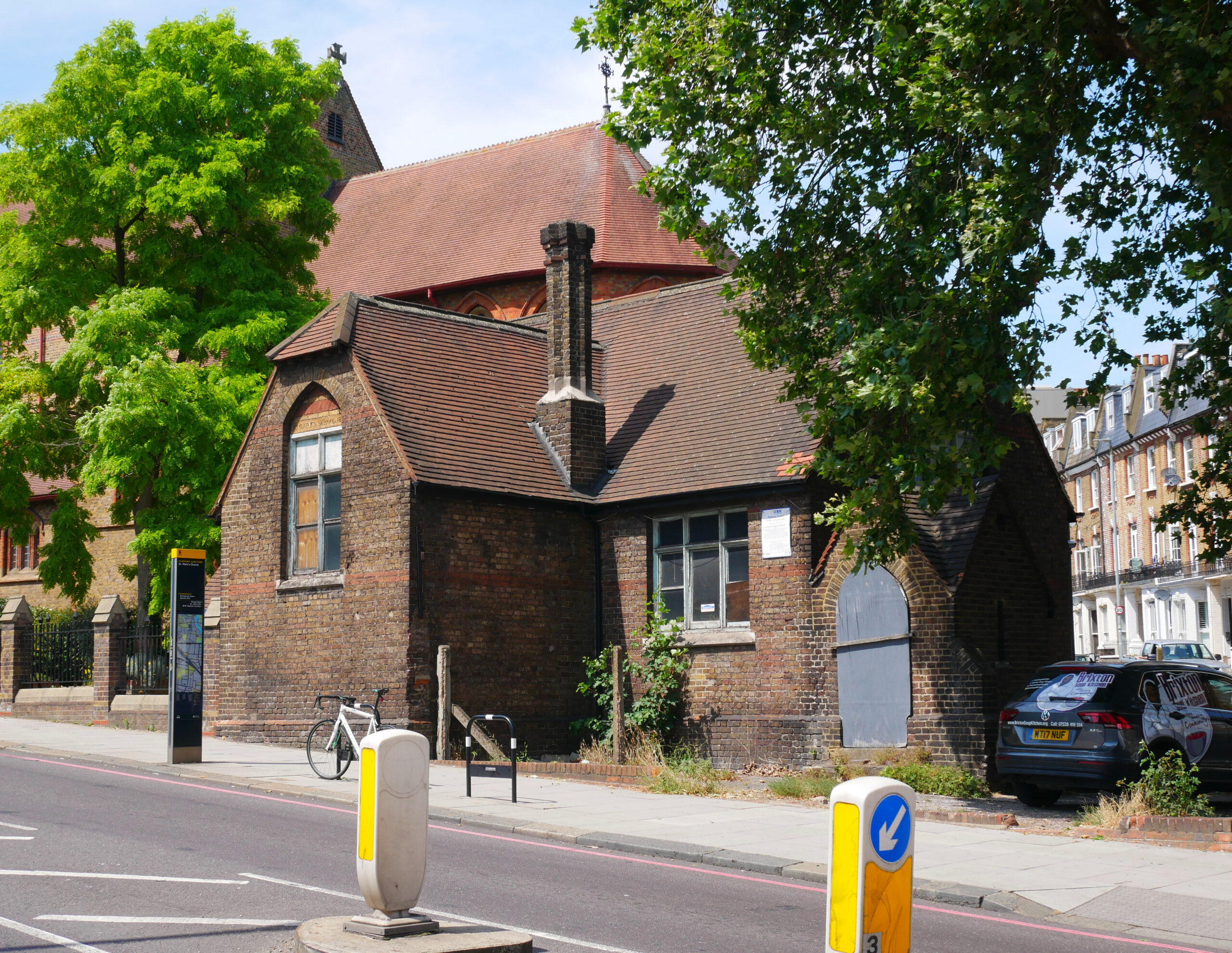
The former St. Mark’s Infant School was built to designs by Benjamin Ferrey, an early proponent of the Gothic Revival who trained under A.C. Pugin, and alongside his better-known son, A.W.N. Pugin, and is regarded as one of the leading church architects of his day. It is unusual in being a diminutive school building designed by a nationally significant architect and it can only be assumed that Ferrey undertook the project on the assumption that it would lead to a more substantial commission, for the adjacent parish church. This passed to William White instead, though the two buildings still maintain significant group value, as the massing builds gradually turning the corner onto Boutflower Road.
The school was built using a pared-back material palette of stock brick with redbrick bands, and is distinguished by its tiled half-hipped roof, interrupted with large polygonal chimneystacks to the angle and the rear. A large Gothic window and door add architectural interest to the otherwise sparse interior spaces, with the former working with other windows to the main block to flood the open space with natural light. The other features of note include typographic inscriptions and polychromatic details which anticipate later Gothic buildings, and a visual dialogue with the street scene.
The school closed at the end of the twentieth century and has been vacant for more than a decade. With each passing year its condition deteriorates and its existing structural problems appear to be worse. The school is still owned by the Diocese of Southwark, and though there has been talk of a buyer and a new community use, progress seems to be deadlocked. For such a small yet presentable building with obvious redevelopment potential to be neglected and unused so close to central London seems extraordinary. The Victorian Society urges the diocese to act now, before it is too late.
Status Update / March 2026
The building was acquired by Dow Jones in 2025 and subsequently converted and refurbished as an architecture studio. The project involved the demolition of one of the chimneystacks, to ensure the structural integrity of the building, but otherwise low-impact and reversible measures were used throughout, with like-for-like repairs completed where appropriate. The practice was keen to retain the scale and openness of the original school room, whilst also making different and intimate areas of work, which resulted in a subtle reorganisation of the internal spaces. The teacher’s office was adapted for use as a library and a small, two-storey timber building was incorporated into the end of the schoolroom, creating an upstairs meeting room and a downstairs space for lunch.