
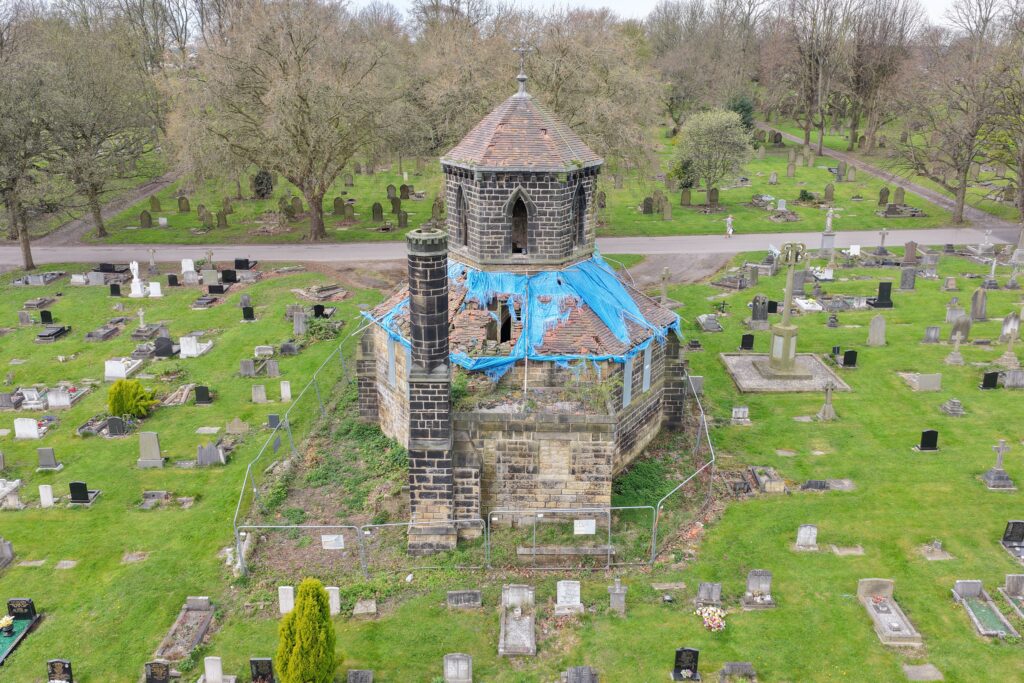
St Michael’s Roman Catholic Cemetery Chapel in Sheffield owned and maintained by Sheffield City Council. Photo: CAV Aerial
Added to the Victorian Society’s Top Ten Endangered Buildings list 2026
Grade II, Charles Hadfield, 1898
St Michael’s Roman Catholic Cemetery Chapel in Sheffield’s City Road Cemetery is a striking example of a once-common building type now in steep decline. Long unused and increasingly unstable, it stands at serious risk, part of a wider national pattern of neglect affecting Victorian cemetery chapels.
The chapel is one of three originally built within Sheffield’s largest municipal cemetery, reflecting the Victorian ambition to create landscaped burial grounds with dedicated spaces for different denominations. Although designated for Roman Catholic use, the building has always been owned and maintained by Sheffield City Council. Its construction was supported by the Duke of Norfolk, a prominent Catholic patron.
Today, the building has been unused for many years and is visibly deteriorating. A specialist report in 2018 identified serious structural concerns, noting that the roof was in extremely poor condition, with missing tiles, vegetation growth and likely compromised structural integrity. Although limited repairs have been carried out to sections of the stonework, there is no clear plan for the building’s future. Attempts to engage both the Council and the Duke of Norfolk’s estate have failed to produce meaningful progress.
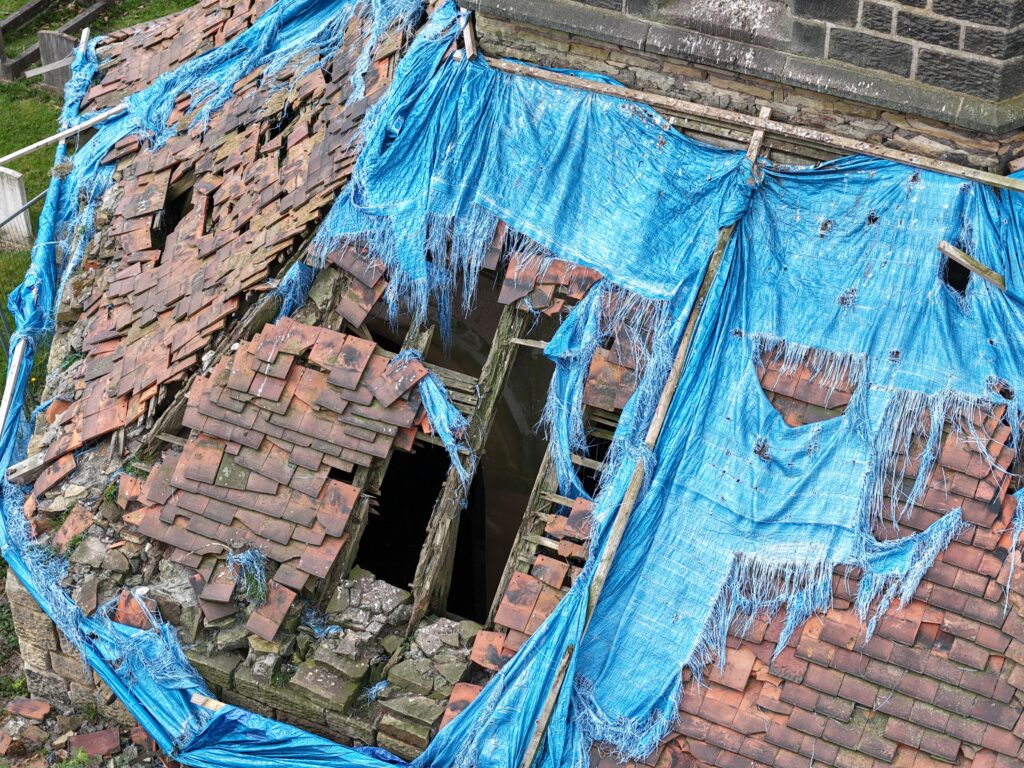
A drone image of the roof showing missing tiles and vegetation growth. Photo: CAV Aerial
The situation is particularly concerning given the wider pressures on the cemetery itself. Sheffield is expected to run out of burial space within the next decade, yet this historic structure, designed to support the rituals and dignity of burial, remains unused and neglected.
The chapel’s origins lie in the Victorian response to rapid urban growth and the need for new burial infrastructure. City Road Cemetery was designed in the tradition of the ‘garden cemetery’, combining landscaped grounds with architectural features that provided both practical and spiritual functions. Mortuary chapels allowed mourners to gather before burial, offering dignity and ceremony within an increasingly crowded urban environment. In Sheffield, provision for Catholic burials came only after sustained lobbying, with contemporary reports describing how mourners had previously been left exposed to the elements during services.
St Michael’s is not an isolated case. Cemetery chapels across England and Wales are falling into disrepair, with increasing numbers now redundant and without clear custodianship. The Victorian Society has previously highlighted this issue, including through a national survey in 2009, yet the situation continues to worsen. The growing number of nominations for such buildings to the Society’s Top Ten list reflects the scale of the problem.
The Victorian Society is calling for urgent action to secure the future of St Michael’s Chapel, and others like it. Without a clear plan for repair and reuse, these buildings, once central to civic and spiritual life, risk being lost entirely.
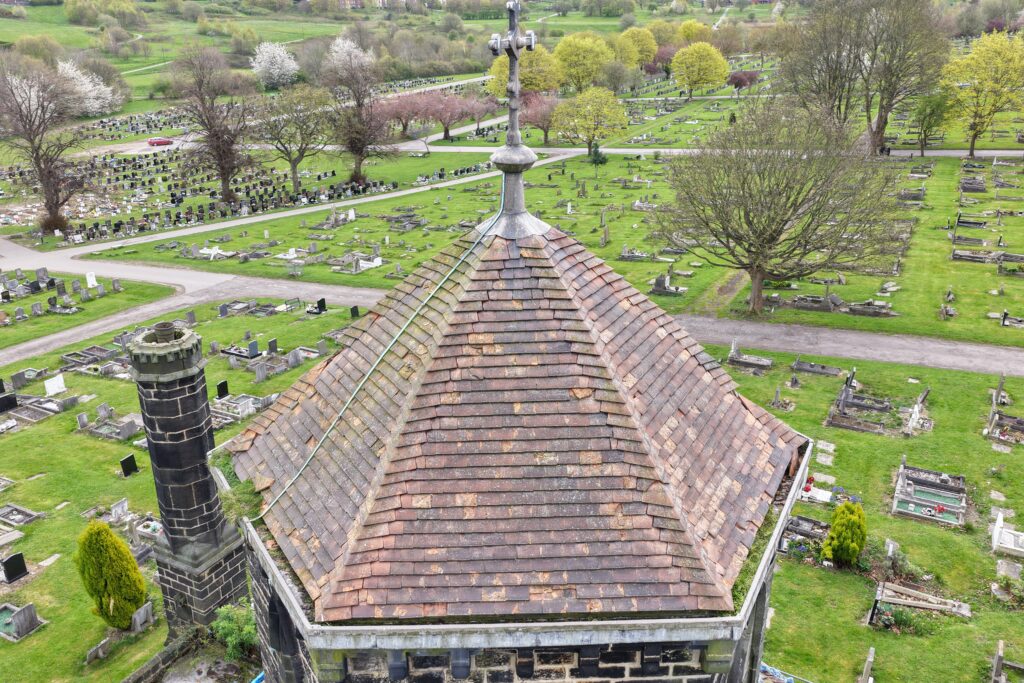
View of tower St Michael’s Cemetery Chapel. Drone photography by CAV Aerial.
Griff Rhys Jones, Victorian Society President, said: “This is a sad story. People are still dying. Cemeteries are getting over full. We need space to bury our dead. And yet we have so many decaying and neglected Chapels of Rest on our books. A report comes. It is in a poor state. The roof is getting dangerous. But reports must be a call to arms. We still value proper burial. We all want proper respect. Some of that value must be turned into action to keep this fine and leading example of a garden cemetery alive and well. The graves and the catholic community deserve no less.”
James Hughes, Director of the Victorian Society, said: ‘‘St Michael’s is part of a much wider and deeply concerning pattern. Cemetery chapels across the country are being lost through neglect and uncertainty over responsibility. These buildings were designed to serve communities at moments of great importance in people’s lives. We must now find new ways to care for them before it is too late.’
The full Top Ten Endangered Buildings list for 2026 of Victorian and Edwardian buildings, and the archive of our previous Top Ten lists, can be viewed here.
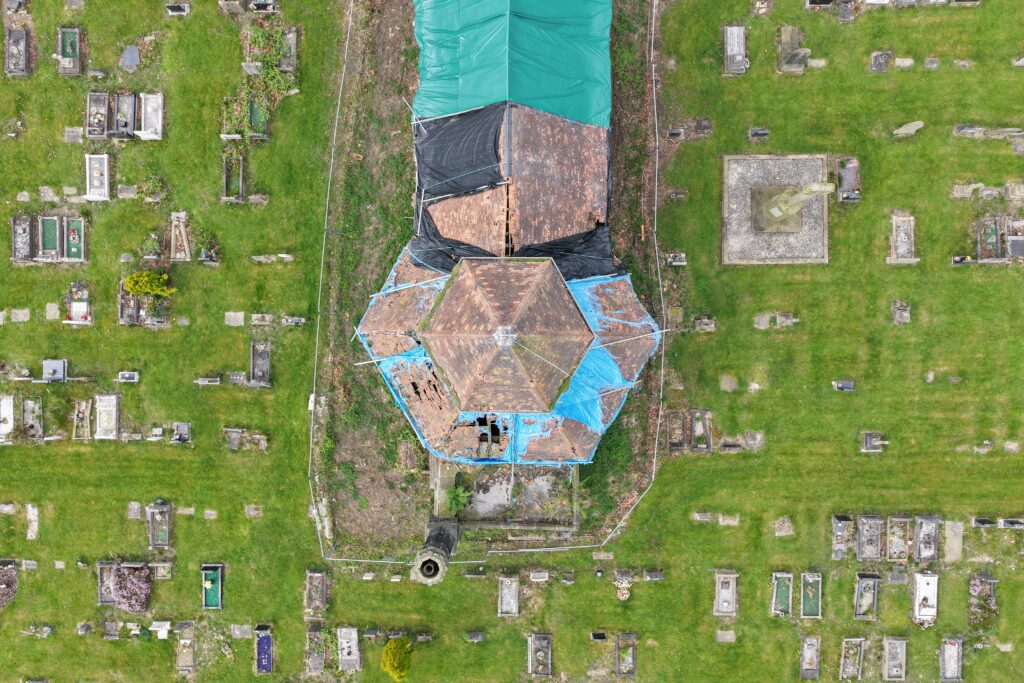
Aerial view of St Michael’s Cemetery Chapel – drone video and photograph by CAV Aerial