
Liverpool, Merseyside
Rodhullandemu, CC BY-SA 4.0
Grade II-listed, 1884, William Douglas Caröe
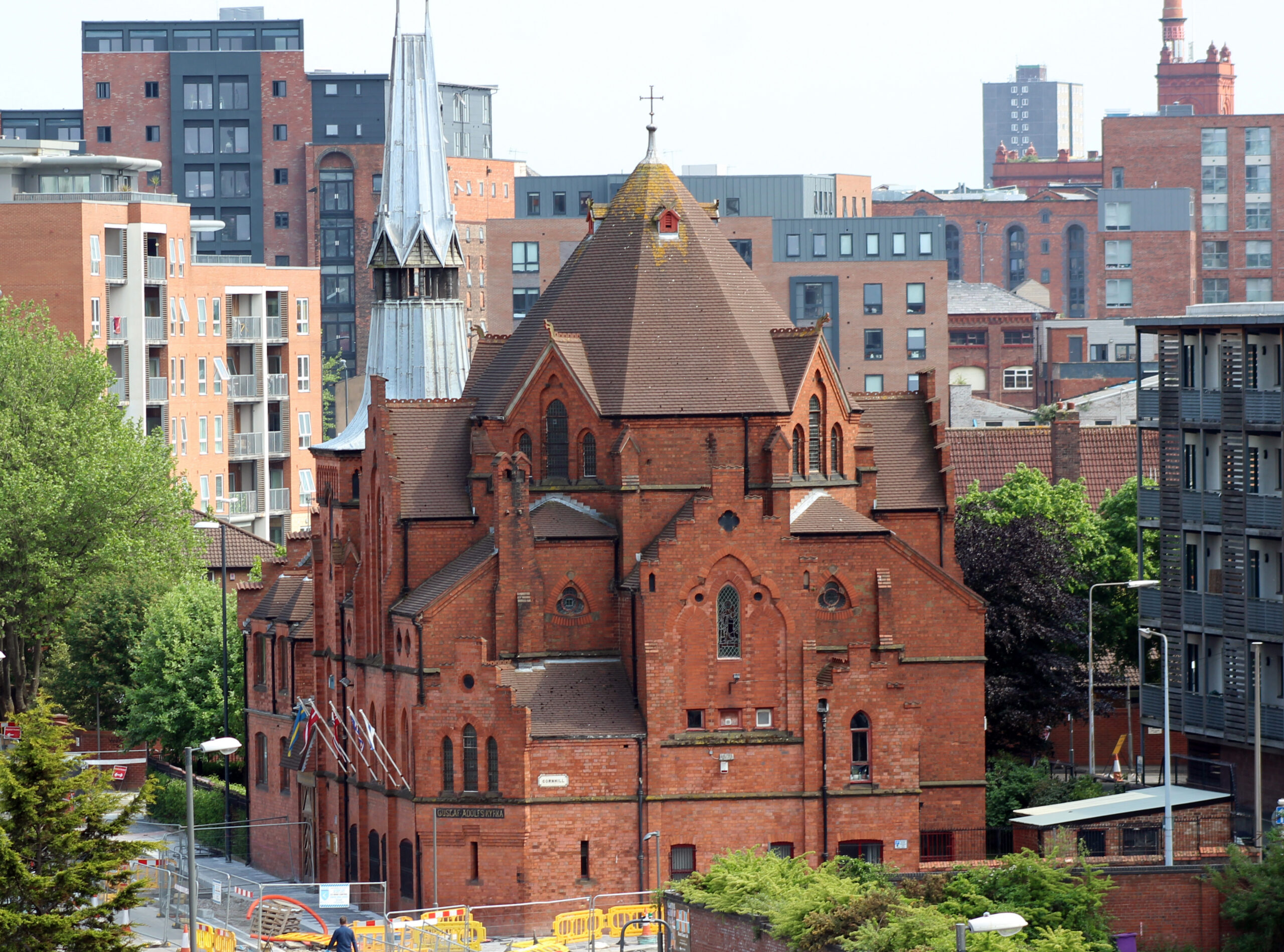
The Gustaf Adolf Seamen’s Church was conceived by the Church of Sweden in 1883, at the height of Liverpool’s prominence as a seaport, on the understanding that Swedish sailors and emigrants were passing through the city and there was a need to sustain their spiritual needs. The elevation drawings were drafted by William Douglas Caröe – who secured the commission through his father, a corn merchant acting as a Danish consul in Liverpool – and are loosely based on traditional Scandinavian stave churches. It is of special architectural interest as the first church designed by Caröe, a leading figure in the Arts and Crafts movement who later specialised in ecclesiastical architecture.
The building is constructed almost entirely of red brick, on an approximately square plan, and consists of a ground-floor mission, a minister’s house, and a church with a shallow chancel flanked by a baptistery and sacristy. The central area of the church is surmounted by an octagonal pyramidal lantern of considerable size, and a significant aspect of the interior design is the uninterrupted view upwards to the ceiling from the first floor. The complexity of the roof structure required a team of Scandinavian craftsmen to be employed to finish it. The associated cost overruns were financed by Caröe’s father, Anders, presumably out of concern for his son’s reputation as an architect.
The church still maintains a strong congregation, and has emerged as an important meeting place for people from the Nordic countries, but the Church of Sweden now intends to pull out of Liverpool, leaving it without a use. The local Friends organisation is working to consider the building’s future, whilst the Council is pushing for the building to be upgraded to Grade II*. We hope these efforts bear fruit as dereliction could spell disaster for this arresting embodiment of Liverpool’s maritime past.
Status Update / March 2026
When the Church of Sweden made the Liverpool International Nordic Community aware of their intention to sell the building, volunteers informed them that there were specific details set down in the 1883 indenture which prevented a sale. The trust communicated with English Heritage and had the building uplisted to Grade II* in 2009, which meant that any further changes required formal approval. Accordingly, a decision was made to retain the church, with management, maintenance, and operational responsibilities transferred to the trust. The church congregation became a separate body in 2013, which enabled them to join the more established Lutheran Church of Great Britain.