

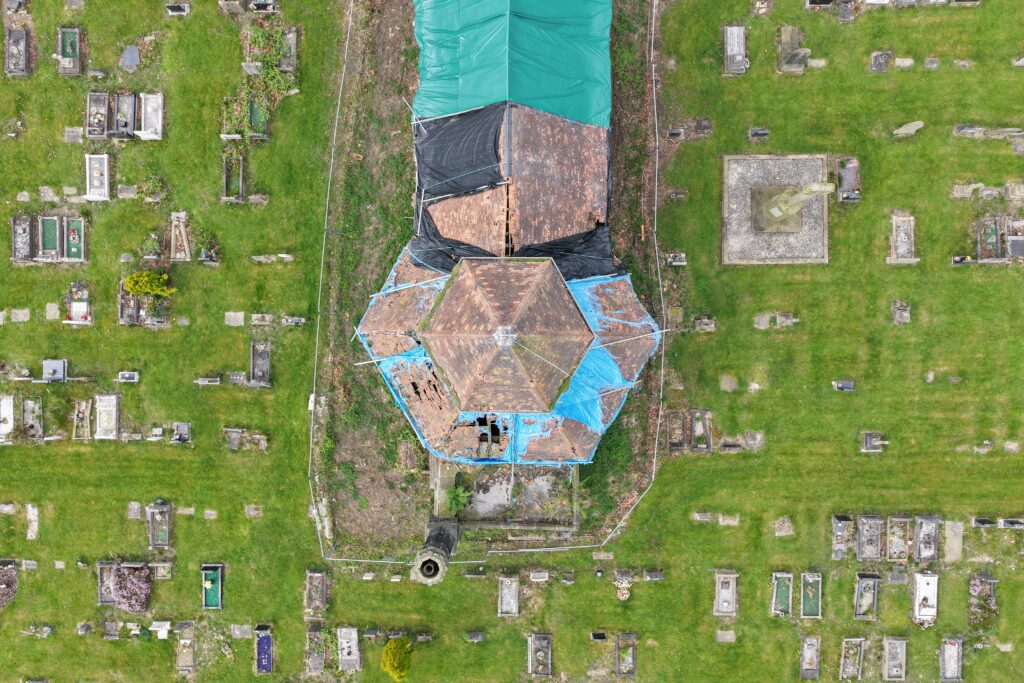
Aerial view of St Michael’s Cemetery Chapel – drone video and photograph by CAV Aerial
The Society’s President Griff Rhys Jones OBE appeared on BBC Radio 4’s Today Programme on 28th April to reveal the Society’s 2026 list of Top Ten Endangered Buildings for England and Wales.
Selected from nominations made by the public, this year’s list highlights a striking and varied group of Victorian and Edwardian buildings at risk, from a nationally iconic transporter bridge, to a rare public health facility, from a Gothic art school to a secluded mausoleum, and from a former railway station at the heart of industrial expansion to a country house containing remarkable painted interiors by a Victorian woman artist.
Together, they tell a powerful story about the buildings that shaped modern Britain, and the growing threats they now face. Despite their historic and architectural importance, many remain vacant, underused, or trapped in cycles of neglect, with uncertain futures and no clear plans for repair or reuse.
The 2026 list includes two Grade II* and eight Grade II listed buildings. While all are protected, listing alone has not been enough to secure their survival. Without intervention, these buildings risk irreversible decline.
The Victorian Society’s Top Ten Endangered Buildings list aims to draw national attention to these at-risk places, encourages debate, and supports efforts to find sustainable new uses. The Society has a strong track record of success, with many previously listed buildings saved through a combination of public pressure, partnership and investment.
The Victorian Society’s Top Ten Endangered Buildings 2026 (in no particular order):
- Hackney Borough Disinfecting Station, London. Grade II, Gordon and Gunton, 1901
- Tees Transporter Bridge, Stockton-on-Tees/Middlesbrough. Grade II*, Engineer: G.C. Imbault, constructed by Sir William Arrol and Co Ltd, 1911
- New Market Hall, Bridgnorth. Grade II, Robert Griffiths of Quatford, 1855 -1859
- Former Strand Railway Station and Railway Men’s Club, Barrow in Furness. Grade II, G. Paley, 1863
- Faenol (Vaynol) Mausoleum, Pentir, Nr Bangor. Grade II, Henry Kennedy of Bangor, late 1870s.
- Oakes School, Huddersfield. Grade II, Charles Fowler, 1873; extended by Ben Stocks, 1885
- Parndon Hall, Harlow. Grade II, Possibly Joseph Clarke, 1867
- St Michael’s RC Cemetery Chapel, Sheffield. Grade II, Charles Hadfield, 1898
- Derby School of Art, Derby. Grade II*, F.W. Waller, 1876 with additions 1899
- Former Library and Mechanics Institute, Devonport. Grade II, A, Norman, 1843-44
Griff Rhys Jones said: “Once again, we are travelling all over England and Wales on a fascinating, enlightening and intriguing tour. Fascinating because from Barrow-in-Furness to Faenol near Bangor, and from Stockton to Hackney we can encounter ten extraordinary survivals from the can-do age. As I always find, these buildings reflect an incredible range of styles and social awareness. They exemplify Victorian ideals. Railways, markets, art schools, institutes, monuments to the dead, chapels and even a transporter bridge: they all become intriguing as soon as you start to examine their stories. They take us straight into the age which provided the building blocks for the society we live in today. So many are the infrastructure projects of the Victorian era. Some are still in use. All are great buildings, executed on demand and with care and foresight. They not only tell the story of our country, they were usually constructed with such strength and integrity that they can continue in service today. There is no building here that cannot be recycled. The desolation comes because all of these candidates for assistance are Grade II listed. Two are Grade II starred, that is, ‘particularly important buildings of more than special interest.’ The Victorian Society is drawing your attention to important buildings that are under threat from decay or neglect. We have had great results in the past. But unless we look to them, deserted or abandoned, fine and beautiful structures can be subject to arson attacks or continued decay. We need to shout out about these ones. They have a future for all of us. They can be reused. That’s the green option. They are each part of the character and quality and history that made Britain and can continue to make Britain.”
James Hughes, Victorian Society Director, said: “This year’s list demonstrates both the richness of our Victorian and Edwardian heritage and the scale of the ongoing challenge in securing its future. These buildings were created with foresight, ambition and a strong sense of civic purpose. Too often today they are left without clear ownership, investment or direction. With the right commitment, every one of them could have a viable future; what is needed now is the will to act.”